DR BLADESDR Blades No. 20

Uzumibi

Beneath the ash, it keeps glowing.
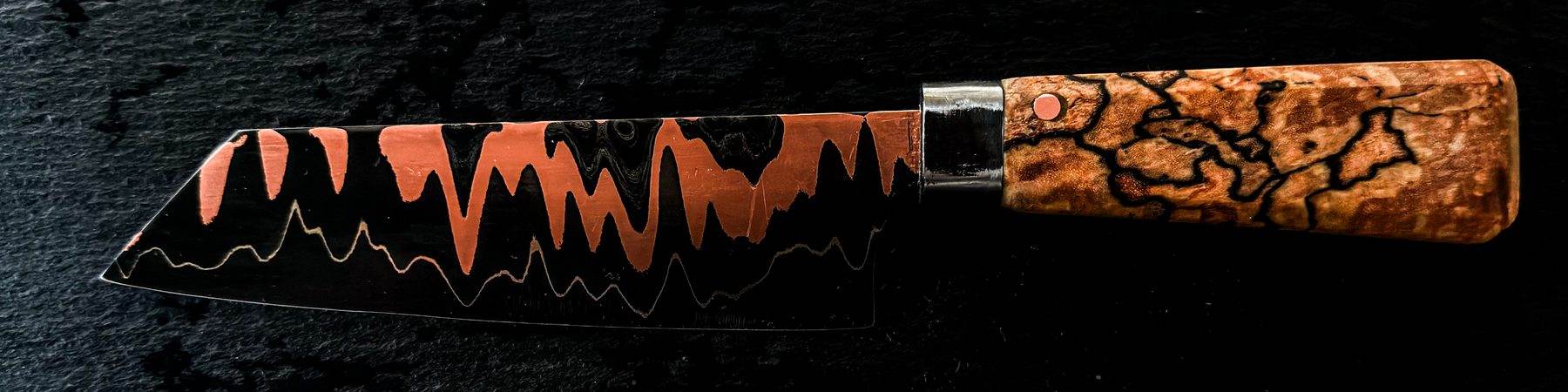
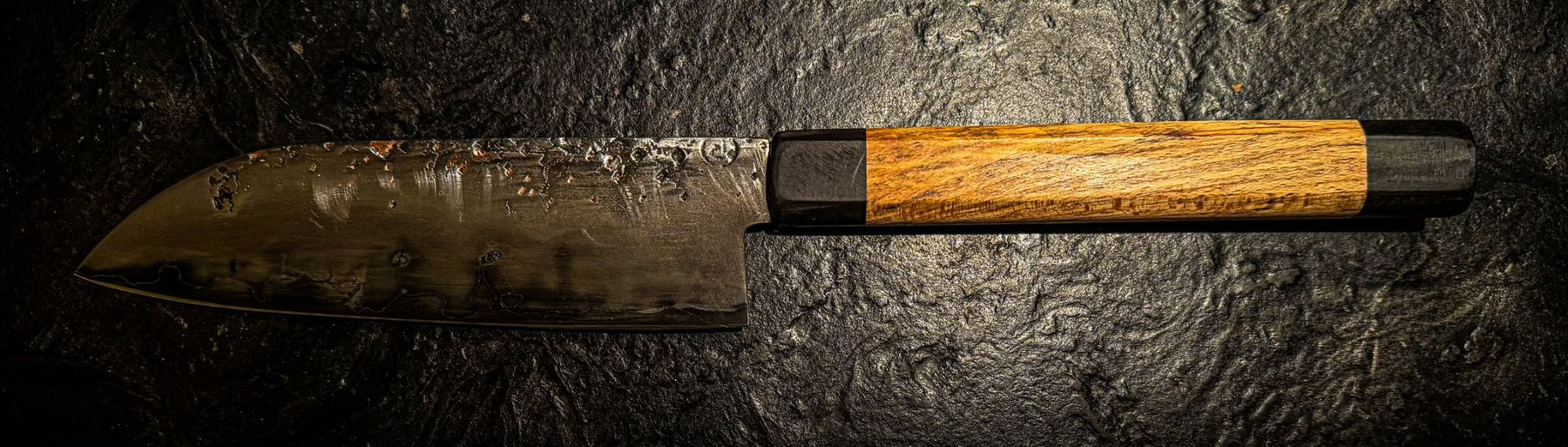
Uzumibi – full knife
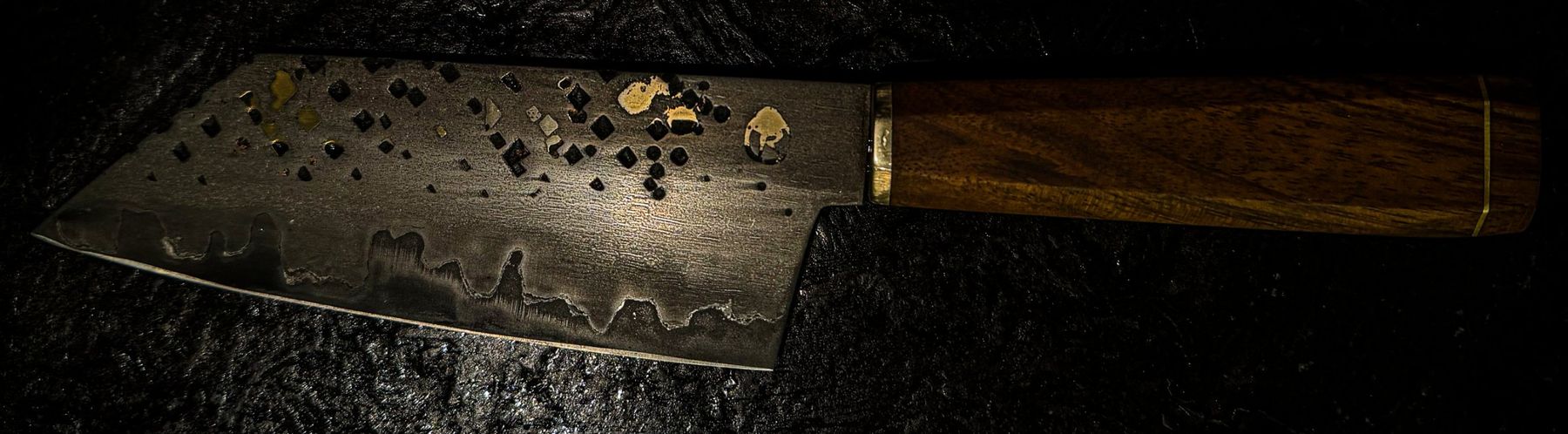
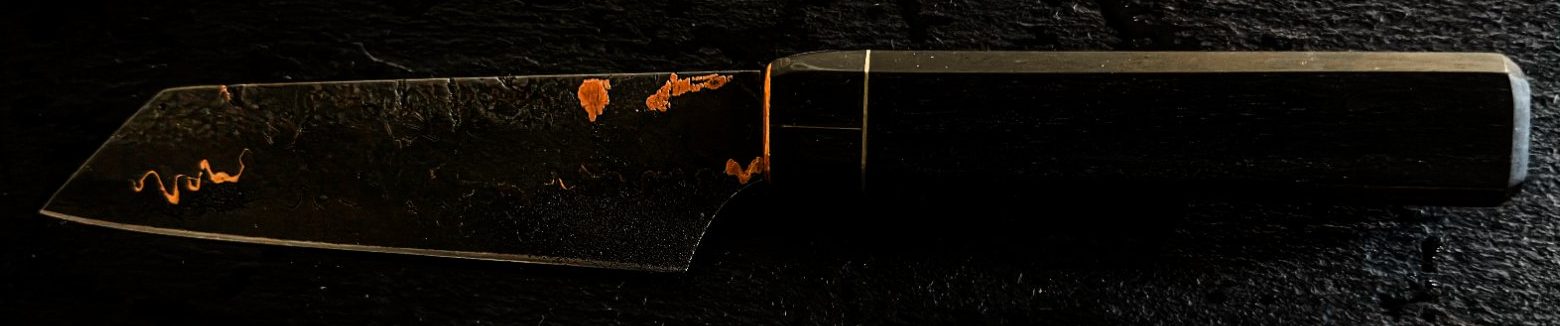
Copper, melted onto the blade, sits in the hollows left by the swage.
It glints red beneath the dark steel, like embers under ash.
A knife that hasn't quite given up its fire.

Uzumibi (埋み火) is Japanese for embers buried under the ash that keep on glowing.

At a glance

Details

The story

Copper and steel won't let go of me. A lot went wrong with Kuro-Samurai. The copper ran out before the layers were welded and in the end showed up as traces on the blade, in places I had never planned. That is exactly what fascinated me. Since then I've been looking for ways to control this effect on purpose.

Uzumibi is one of the first experiments in that direction. I first worked the surface of the blade with a swage. After forging, I melted the copper onto the surface in the forge. It ran into the hollows and now sits where the swage pressed into the steel.

The forged blank with the outline marked. The hollows from the swage and the copper are already visible.

The result isn't perfect yet, and neither is the construction. The cutting core is an old file, set into mild steel using the warikomi method. The forge welding didn't really work well. The mild steel was hard to split, and I could barely get the slag out of the gap before inserting the core. You can still see that on the blade.
After grinding: copper in the hollows, below it the line of the cutting core
Blade and handle parts: water buffalo horn ferrule, spalted beech and the ebony end cap with the NFC mark

From material to blade

  1. Copper in the fire
    01

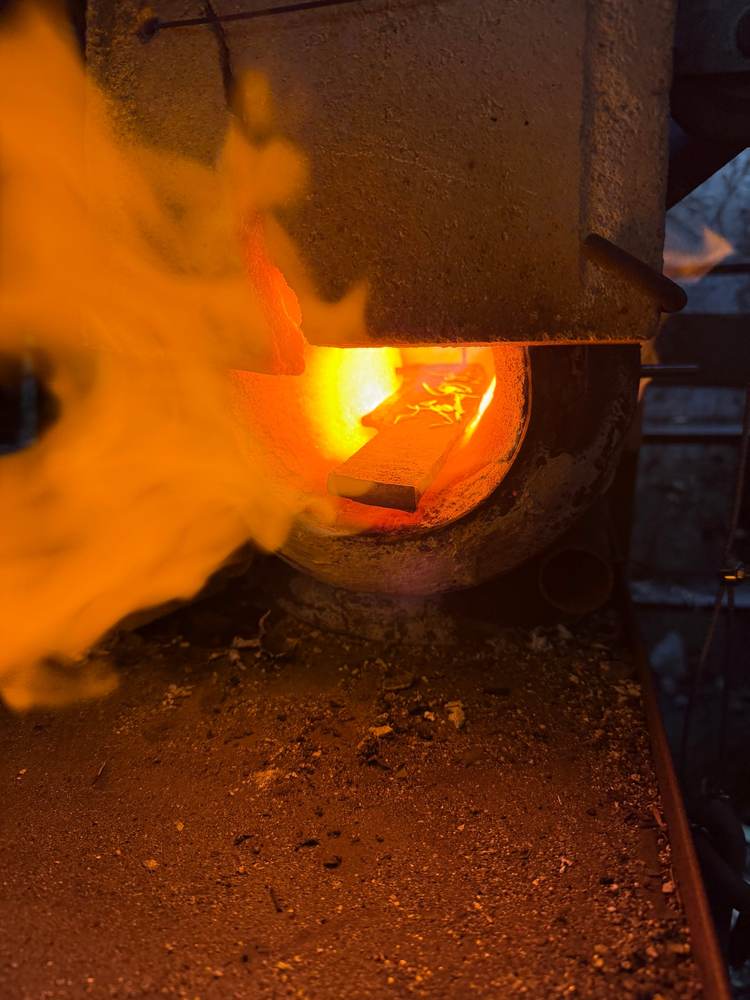
    Copper in the fire

    The pieces of copper lie on the forged blank in the gas forge and melt.

  2. The handle
    02

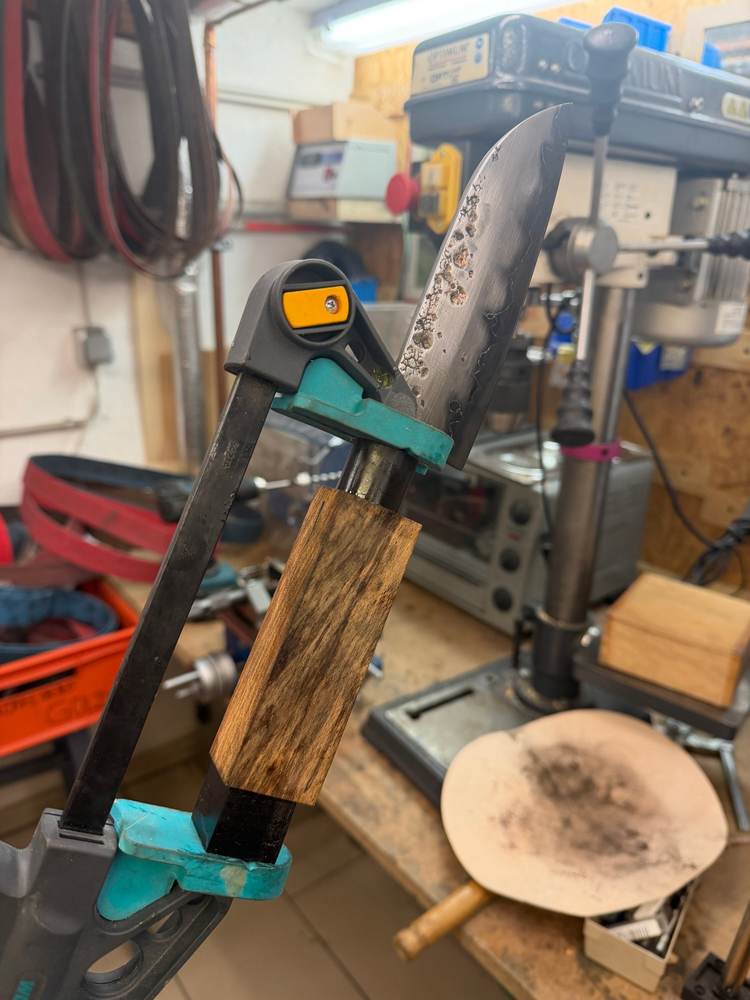
    The handle

    Ferrule, handle wood and end cap are glued to the blade.

Of copper and steel

Specifications

Steel
Cutting coreold file from my stock
Claddingmild steel from my stock
ConstructionWarikomi
Finishswage texture, copper melted on in the forge after forging
Etchferric chloride, coffee
ForgeGas
Working timeapprox. 12 hours
Heat treatment
Hardening840 °C
QuenchOil, 60 °C
Tempering2 × 1 h at 200 °C
Hardness
58HRC
estimated (file test)
Dimensions
Overall length340 mm
Blade length155 mm
Blade height45 mm
Spine thickness5 mm
Weight162 g
Handle
Woodspalted beech from my stock, stabilised
FerruleWater buffalo horn
End capebony with NFC chip
ShapeWa handle, octagonal
TangHidden tang
Work
TypeSantoku
Work no.20
CompletedNovember 2026

The smith

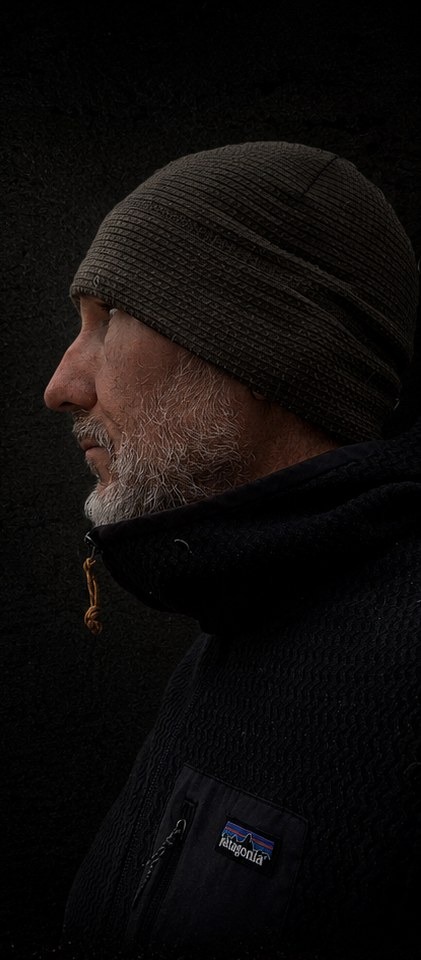
The smith behind DR BLADES

DR BLADES

DR are my initials and also stand for my academic degree. The pun was too good to just leave sitting around. As a drug hunter and researcher, I'm fascinated by how a small molecule has to be built so that it does exactly what it should at its biological target, and how, after a lot of optimization, it eventually becomes a drug. Structure determines function. One more or less atom, one bond that is twisted differently, and everything changes.

I find the very same thing at the forge. Here, too, shape and properties determine what a knife can do in the end. Hardly any material can be transformed like steel. The temperature control alone decides whether the same blade turns out soft, hard, too brittle or just right.

I bring many of my materials back from travels and outdoor activities. A rusty axe head found between the rocks on a Norwegian fjord, Aogami and Shirogami from Sakai in Japan, masur birch from Karelia, reindeer and moose antler from Lapland. Others come from our garden or from friends.

Each one carries a piece of history. It shouldn't disappear in the finished knife. The old iron is allowed to look old, the wood to show its wounds. That is exactly what each of my knives tells.

Care