DR BLADESDR Blades No. 16

Beni-Fuji

Where copper glows, the mountain awakens.
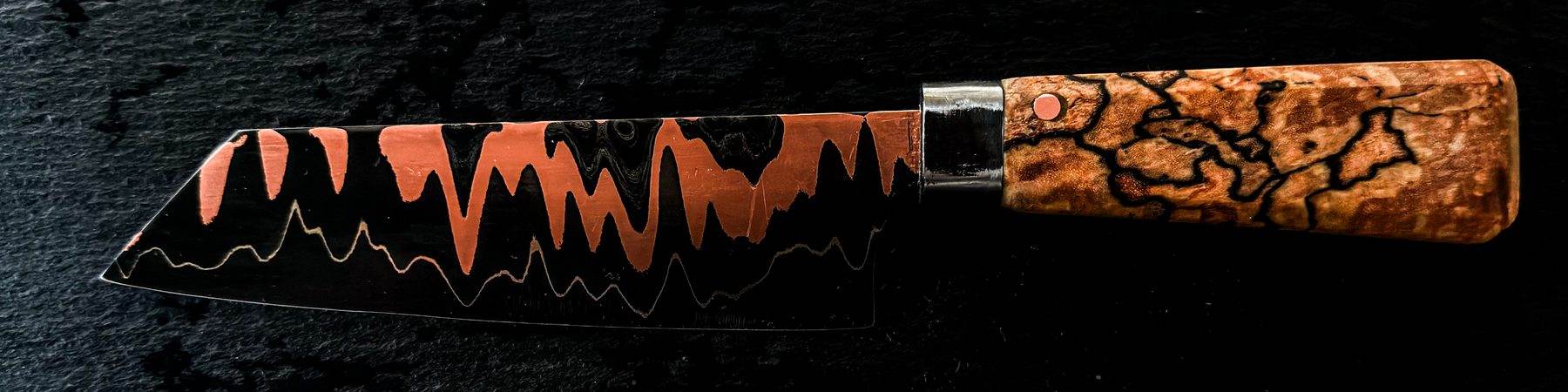
Beni-Fuji – full knife
Damascus and copper, dared twice.
This time the fire kept its word.
The mountain glows red in the first light.

Beni-Fuji (紅富士) is Japanese and means “red Fuji”. That is what the sacred mountain is called when the morning or evening sun makes it glow red. In Japan the sight is considered a sign of good luck. On this blade the copper spikes stand like glowing peaks above the dark Damascus, and below them the bright line runs like a second ridge. I was lucky enough to see Fuji glowing like this in the summer of 2026.

Fuji in the evening light, summer 2026

At a glance

Details

The story

Joining copper and steel is a challenge. Copper melts at about 1085 °C, and steel only forge-welds close to that temperature. The window is narrow. With Kuro-Samurai I ended up on the wrong side of it, and the copper ran out.

With Beni-Fuji I took a different route. First I forged a Damascus from manganese and nickel steel. Only then did I join it with copper as a San Mai: the copper layer sits between the Damascus and the Apex Ultra cutting core. This time it held. After grinding and etching, the copper rises across the blade in bold spikes, like a mountain range in the evening light.

The handle is spalted beech from the Palatinate Forest. Its black lines form when fungi work their way through the wood before it dries. It is secured with a copper pin and finished with a nickel silver ferrule.
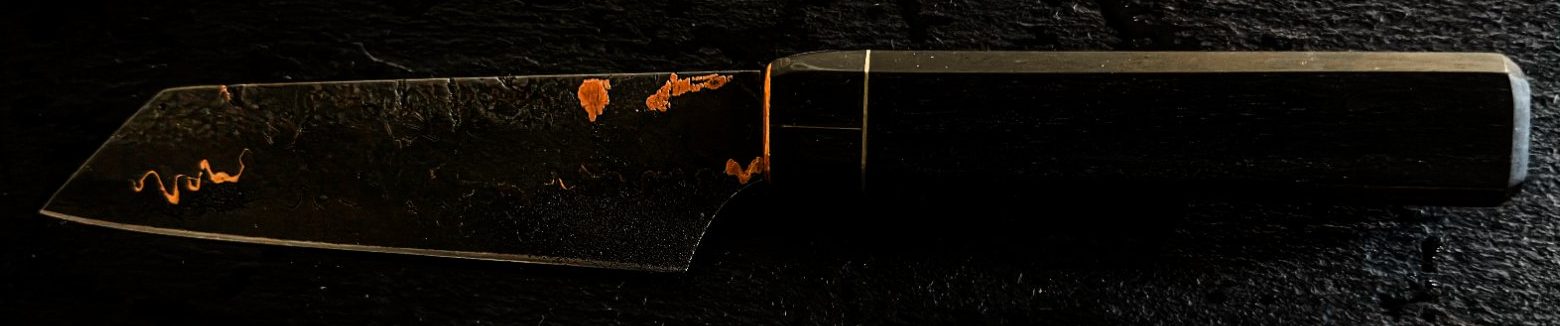
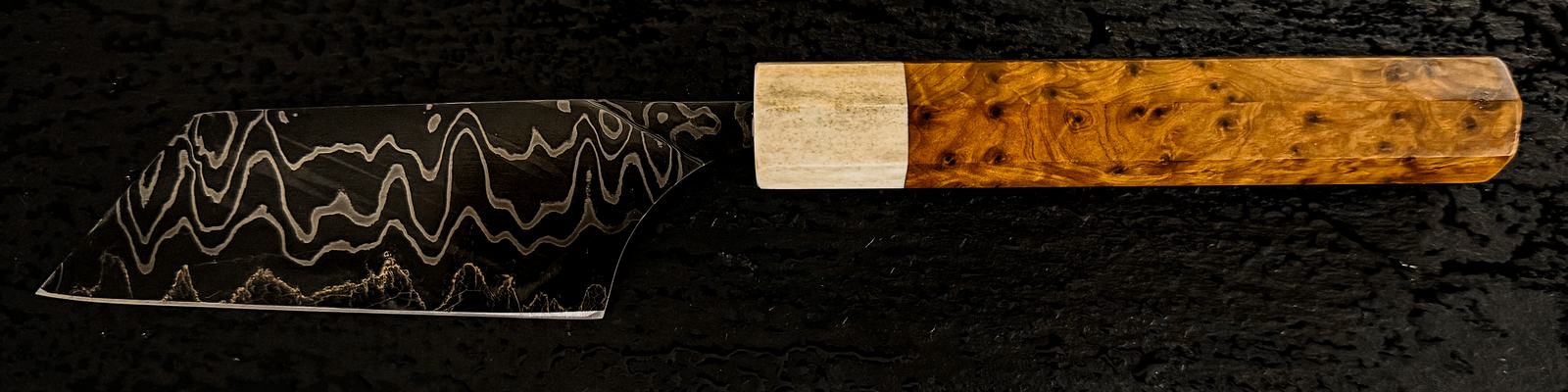
Of copper and Damascus

Specifications

Steel
Cutting coreApex Ultra, Austria
Side layersDamascus of manganese and nickel steel
InterlayerCopper
ConstructionCu-Mai
PatternRandom · 25 layers
Finishetched
Etchferric chloride, coffee
ForgeGas
Working timeapprox. 17 hours
Heat treatment
Normalizing950 °C
Hardening840 °C
QuenchOil, 60 °C
Tempering2 × 1 h at 210 °C
Hardness
63HRC
estimated (file test)
Dimensions
Overall length250 mm
Blade length137 mm
Blade height37 mm
Spine thickness2.4 mm
Weight100 g
Handle
WoodSpalted beech from the Palatinate Forest, stabilized
FerruleNickel silver
PinCopper
ShapeWa handle
TangHidden tang
Work
TypeBunka
Work no.16
CompletedFebruary 2026

The smith

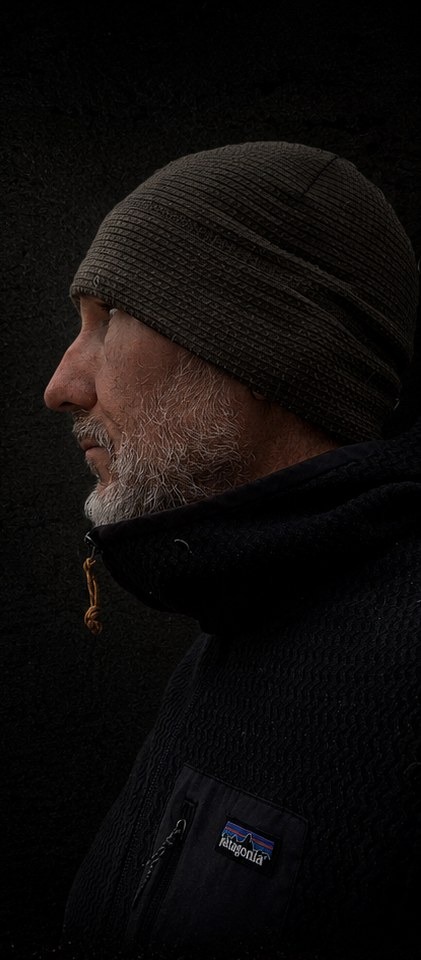
The smith behind DR BLADES

DR BLADES

DR are my initials and also stand for my academic degree. The pun was too good to just leave sitting around. As a drug hunter and researcher, I'm fascinated by how a small molecule has to be built so that it does exactly what it should at its biological target, and how, after a lot of optimization, it eventually becomes a drug. Structure determines function. One more or less atom, one bond that is twisted differently, and everything changes.

I find the very same thing at the forge. Here, too, shape and properties determine what a knife can do in the end. Hardly any material can be transformed like steel. The temperature control alone decides whether the same blade turns out soft, hard, too brittle or just right.

I bring many of my materials back from travels and outdoor activities. A rusty axe head found between the rocks on a Norwegian fjord, Aogami and Shirogami from Sakai in Japan, masur birch from Karelia, reindeer and moose antler from Lapland. Others come from our garden or from friends.

Each one carries a piece of history. It shouldn't disappear in the finished knife. The old iron is allowed to look old, the wood to show its wounds. That is exactly what each of my knives tells.

Care