DR BLADESDR Blades No. 10

Wadachi

From wheel to blade.
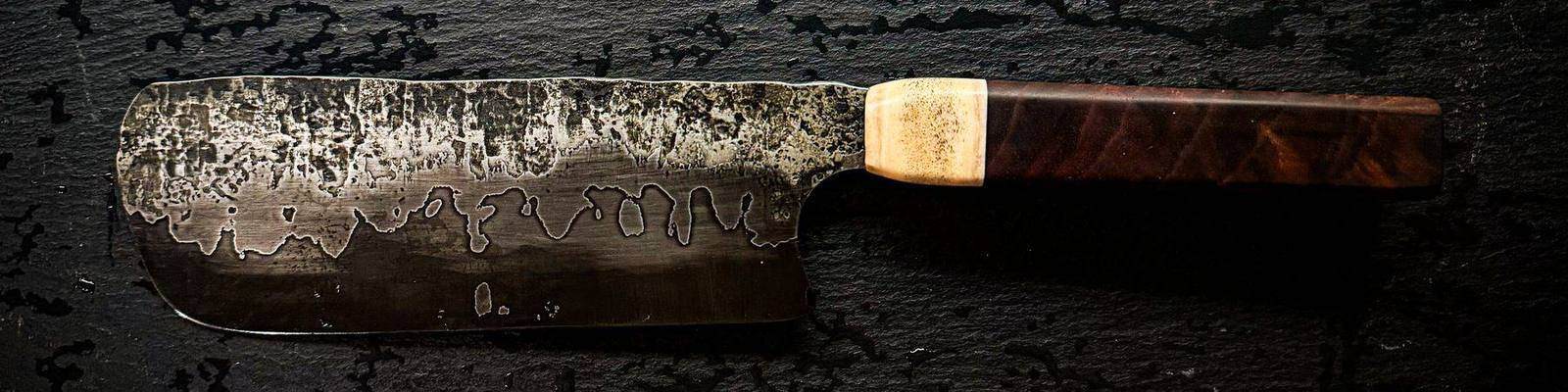
Wadachi – full knife
Once the iron bore the burden of the roads.
In the fire it found a new form.
Now it leaves its own track.

Wadachi (轍) is Japanese for wheel track. The outer layer of the blade comes from an old wagon wheel – and the bright, curving lines of nickel in the steel trace that track.

At a glance

Details

The story

Two paths meet in this blade. One begins in 19th-century Germany: the wrought iron comes from an old wagon wheel that once carried heavy loads over countless roads.

The other begins in Sakai, Japan’s historic smithing city. That is where the Aogami cutting core comes from, the “blue paper.” It is named after the paper the steelworks wrap their bars in so smiths can tell the grades apart – blue paper for the steel alloyed with chromium and tungsten. It is valued for its sharpness and edge retention.

I folded and forge-welded the wagon wheel iron several times with a few offcuts of nickel steel before it was split using the Warikomi method and welded to the Aogami core. 25 layers and an etch in ferric chloride and coffee brought out the track that gives the knife its name.

The cherry laurel for the handle grew in our garden. A piece of home that now carries the blade.
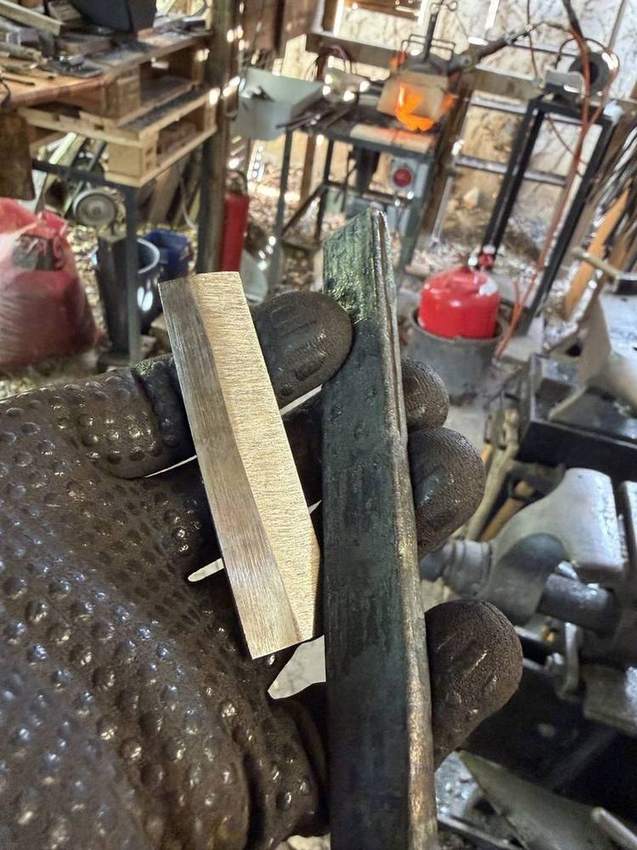
From material to blade

  1. The material
    01

    The material

    Aogami from Sakai and the wrought iron of the wagon wheel.

  2. Fire
    02

    Fire

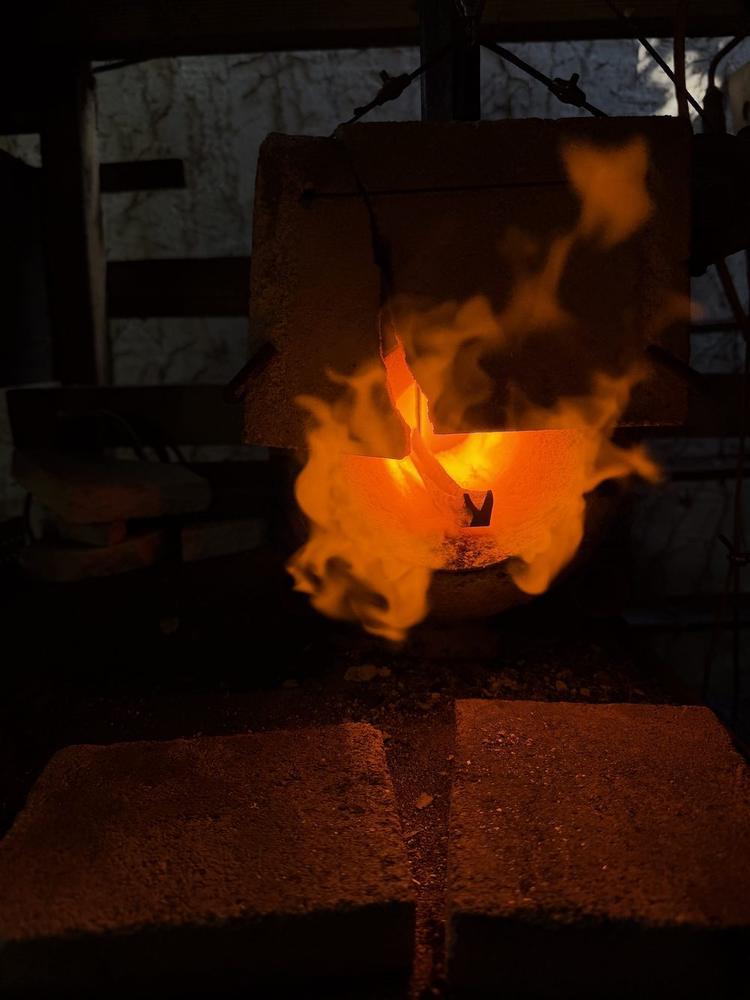
    In the gas forge, iron and steel are forge-welded – 25 layers.

  3. The blank
    03

    The blank

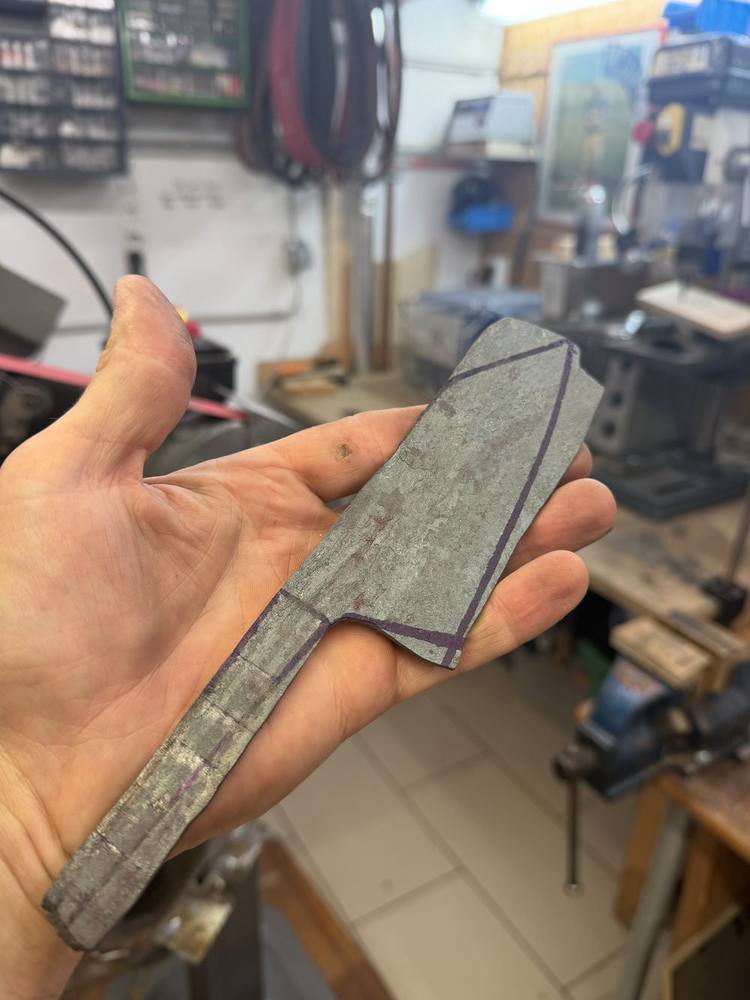
    Forged out, with the Bunka shape scribed on.

  4. Hardening
    04

    Hardening

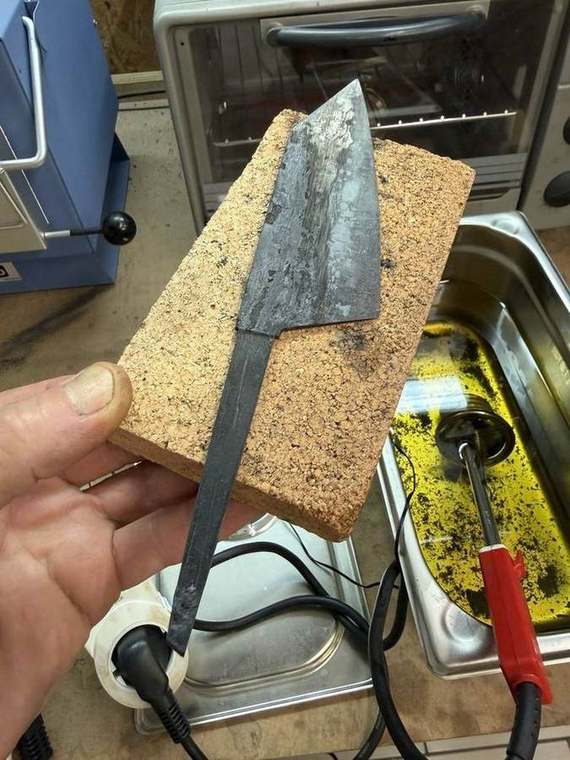
    At 820 °C into 60 °C oil, then tempered twice.

  5. The handle takes shape
    05

    The handle takes shape

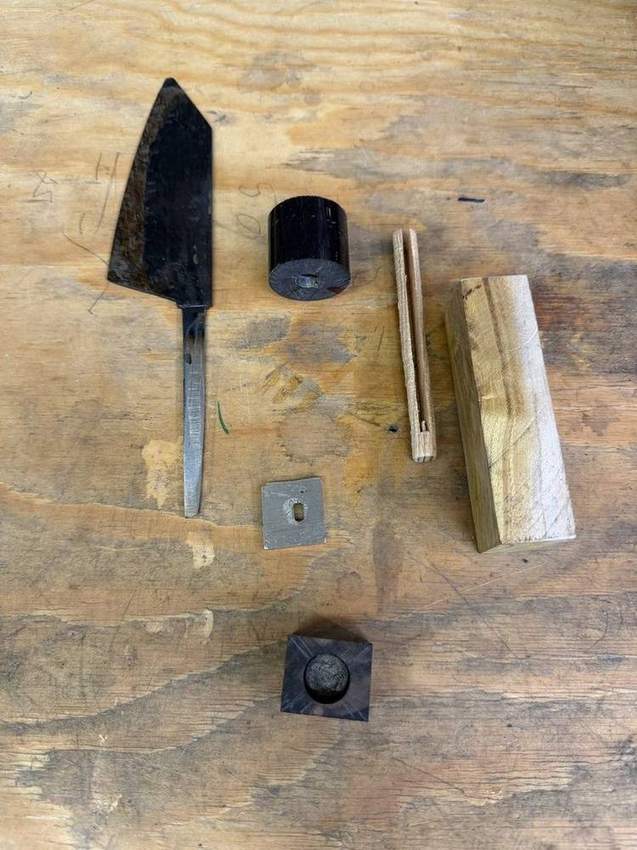
    Hardened blade, horn, cherry laurel – ready for assembly.

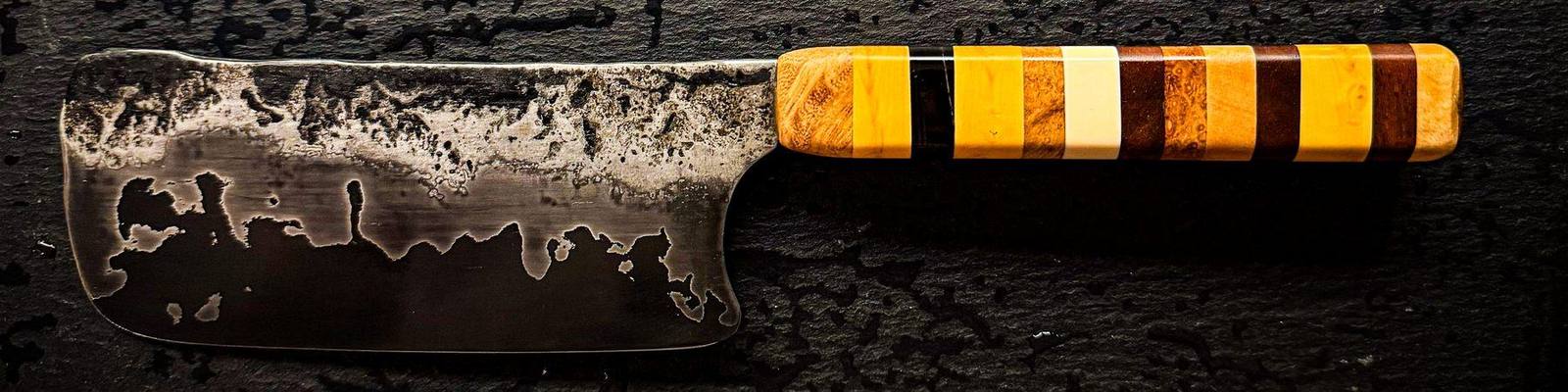
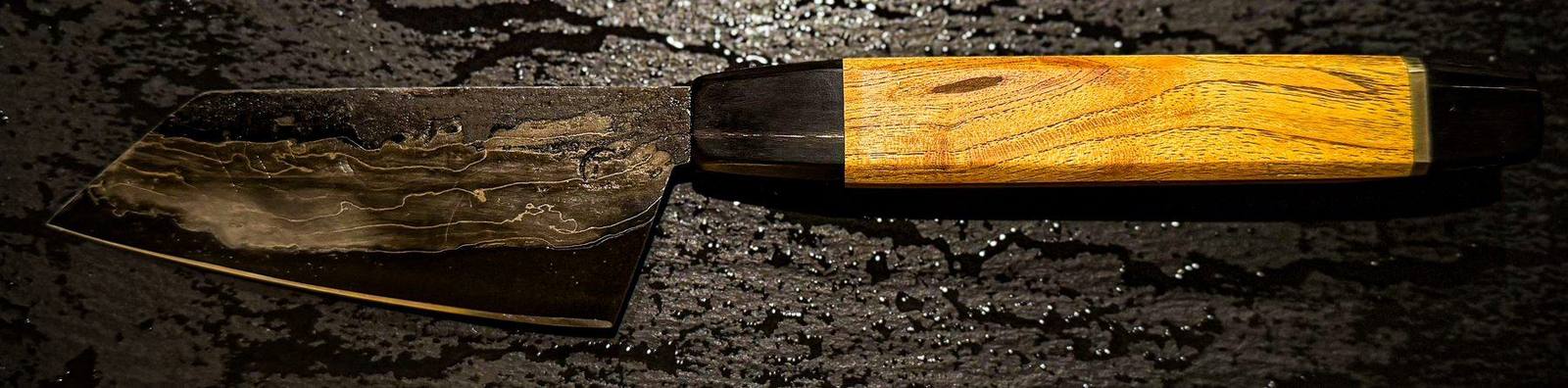
From the same wheel

Specifications

Steel
Cutting coreAogami (blue paper steel) from Sakai, Japan
CladdingWrought iron from a wagon wheel, Germany, 19th c.
ConstructionWarikomi
PatternRandom · 25 layers
Etchferric chloride, coffee
ForgeGas
Working timeapprox. 21 hours
Heat treatment
Normalizing830 / 790 / 760 °C
Hardening820 °C
QuenchOil, 60 °C
Tempering2 × 1 h at 190 °C
Hardness
60HRC
estimated (file test)
Dimensions
Overall length270 mm
Blade length106 mm
Blade height42 mm
Spine thickness3 mm
Weight108 g
Balance pointWhere the handle meets the ferrule
Handle
WoodCherry laurel from our garden, not stabilized
FerruleWater buffalo horn
ShapeWa handle, octagonal
TangHidden tang
Work
TypeBunka
Work no.10
CompletedSeptember 2026

The smith

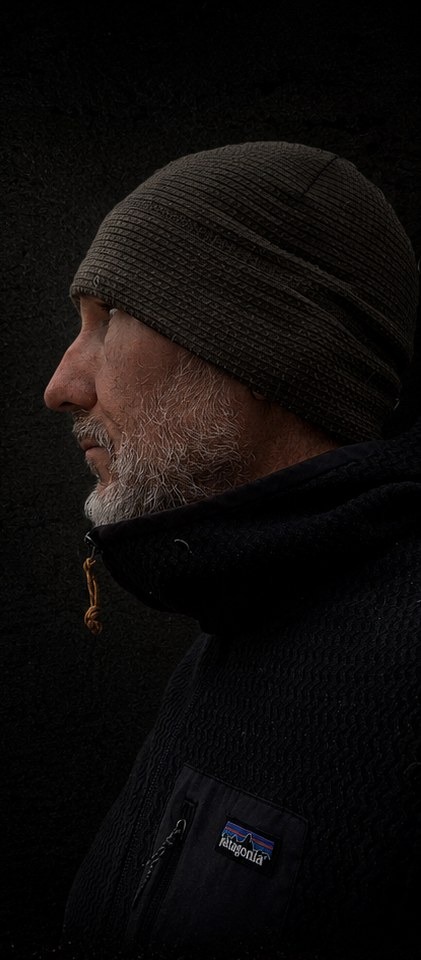
The smith behind DR BLADES

DR BLADES

DR are my initials and also stand for my academic degree. The pun was too good to just leave sitting around. As a drug hunter and researcher, I'm fascinated by how a small molecule has to be built so that it does exactly what it should at its biological target, and how, after a lot of optimization, it eventually becomes a drug. Structure determines function. One more or less atom, one bond that is twisted differently, and everything changes.

I find the very same thing at the forge. Here, too, shape and properties determine what a knife can do in the end. Hardly any material can be transformed like steel. The temperature control alone decides whether the same blade turns out soft, hard, too brittle or just right.

I bring many of my materials back from travels and outdoor activities. A rusty axe head found between the rocks on a Norwegian fjord, Aogami and Shirogami from Sakai in Japan, masur birch from Karelia, reindeer and moose antler from Lapland. Others come from our garden or from friends.

Each one carries a piece of history. It shouldn't disappear in the finished knife. The old iron is allowed to look old, the wood to show its wounds. That is exactly what each of my knives tells.

Care