DR BLADESDR Blades No. 14

Aowa

From one wheel, two paths.
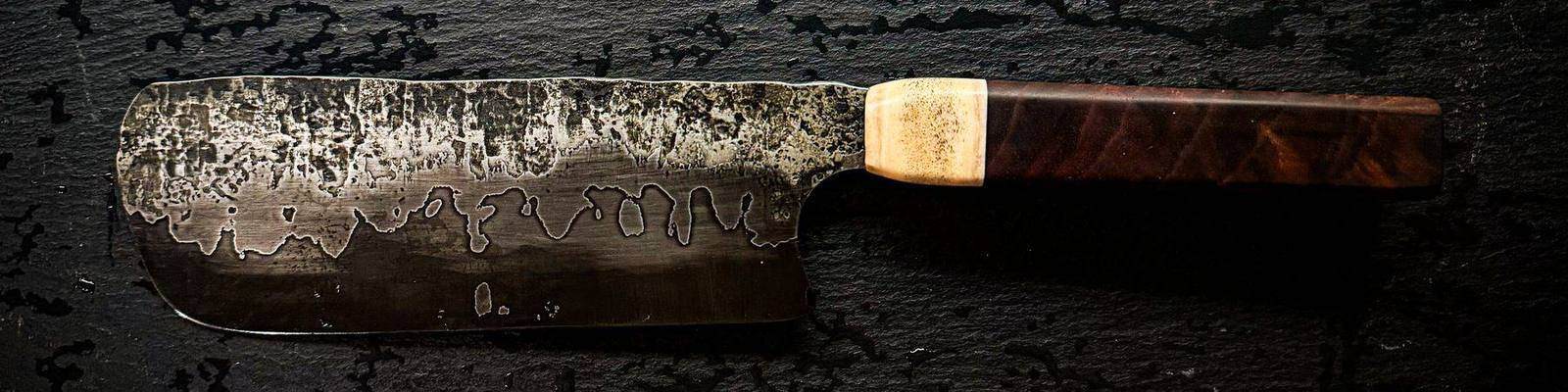
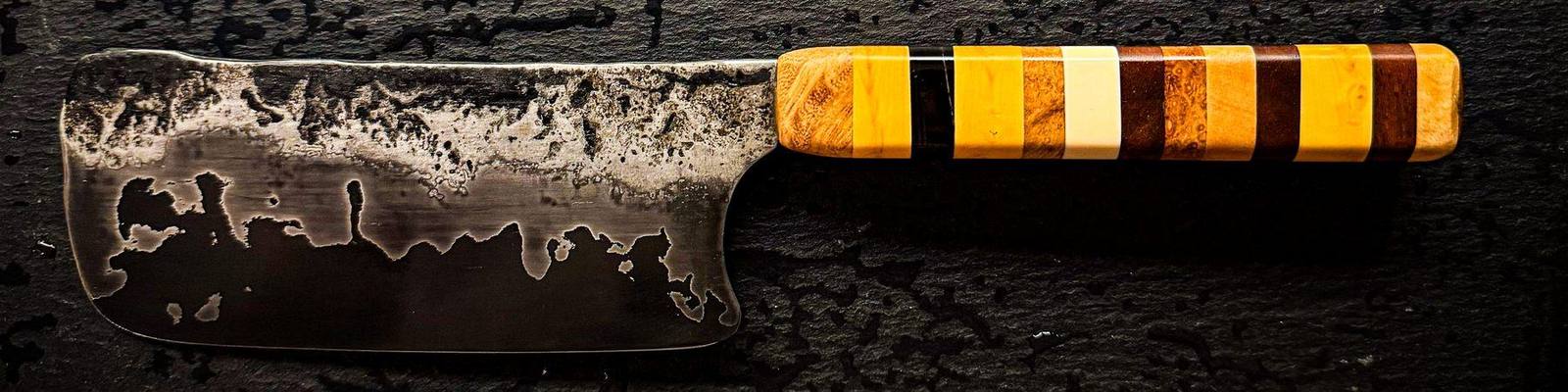
Aowa – full knife
Joined from leftovers, piece by piece,
each wood with its own story.
Together they carry the blade.

Aowa (青輪) means “blue wheel”. The cutting core is Aogami, “blue paper”, and the side layers come from an old wagon wheel. Together with Shirowa, Aowa forms a pair – kuruma no ryōrin, the two wheels of a cart, which only move forward together. Aogami literally means “blue paper”. The name comes from the packaging: the steelworks in Yasugi in Shimane Prefecture (Hitachi Metals, today Proterial) wraps its steel bars in colored paper so the smiths can tell the grades apart – blue paper for the steel alloyed with chromium and tungsten, white paper for the plain carbon steel.

At a glance

Details

The story

Aowa is Shirowa’s sister knife. I forged the two side by side right after I got back from Japan in the summer of 2026. They were my first Nakiri, and I wanted to see how the two steels from Sakai differ that Tadashi Enami had cut off for me. The cutting core of this knife is Aogami, which has chromium and tungsten added. That makes it a little tougher, and it holds its edge longer. The side layers come from the same old wagon wheel as Shirowa and Wadachi.

The blade is ground very thin and extremely sharp, the spine deliberately left natural.

The handle is put together from leftover pieces: curly birch, maple, ebony, mammoth ivory, walnut and tigerwood. Each piece was left over from another project. Together they tell a little about all the knives that came before.

Aowa is a gift for my dear wife!
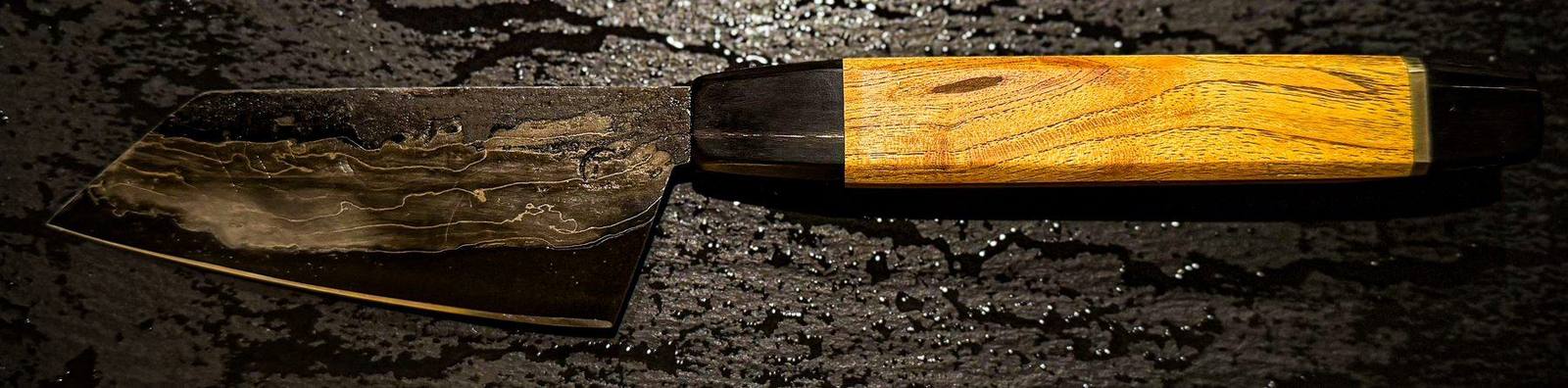
From the same wheel

Specifications

Steel
Cutting coreAogami, from Tadashi Enami, Sakai (Japan)
Side layersWrought iron from a wagon wheel (19th c., Germany)
ConstructionSan Mai
Finishetched, spine left natural
Etchferric chloride, coffee
ForgeGas
Working timeapprox. 21 hours
Heat treatment
Normalizing830 / 790 / 760 °C
Hardening820 °C
QuenchOil, 60 °C
Tempering2 × 1 h at 190 °C
Hardness
>60HRC
estimated (file test)
Dimensions
Overall length250 mm
Blade length125 mm
Blade height52 mm
Spine thickness3.5 mm
Weight148 g
Handle
WoodLeftover pieces: curly birch, maple, ebony, mammoth ivory, walnut, tigerwood
FerruleCurly birch, Karelia (Finland, summer 2025)
ShapeWa handle, square
TangHidden tang
Work
TypeNakiri
Work no.14
CompletedAugust 2026

The smith

The smith behind DR BLADES

DR BLADES

DR are my initials and also stand for my academic degree. The pun was too good to just leave sitting around. As a drug hunter and researcher, I'm fascinated by how a small molecule has to be built so that it does exactly what it should at its biological target, and how, after a lot of optimization, it eventually becomes a drug. Structure determines function. One more or less atom, one bond that is twisted differently, and everything changes.

I find the very same thing at the forge. Here, too, shape and properties determine what a knife can do in the end. Hardly any material can be transformed like steel. The temperature control alone decides whether the same blade turns out soft, hard, too brittle or just right.

I bring many of my materials back from travels and outdoor activities. A rusty axe head found between the rocks on a Norwegian fjord, Aogami and Shirogami from Sakai in Japan, masur birch from Karelia, reindeer and moose antler from Lapland. Others come from our garden or from friends.

Each one carries a piece of history. It shouldn't disappear in the finished knife. The old iron is allowed to look old, the wood to show its wounds. That is exactly what each of my knives tells.

Care