DR BLADESDR Blades No. 8

Konami

Even the small wave carries the sea.
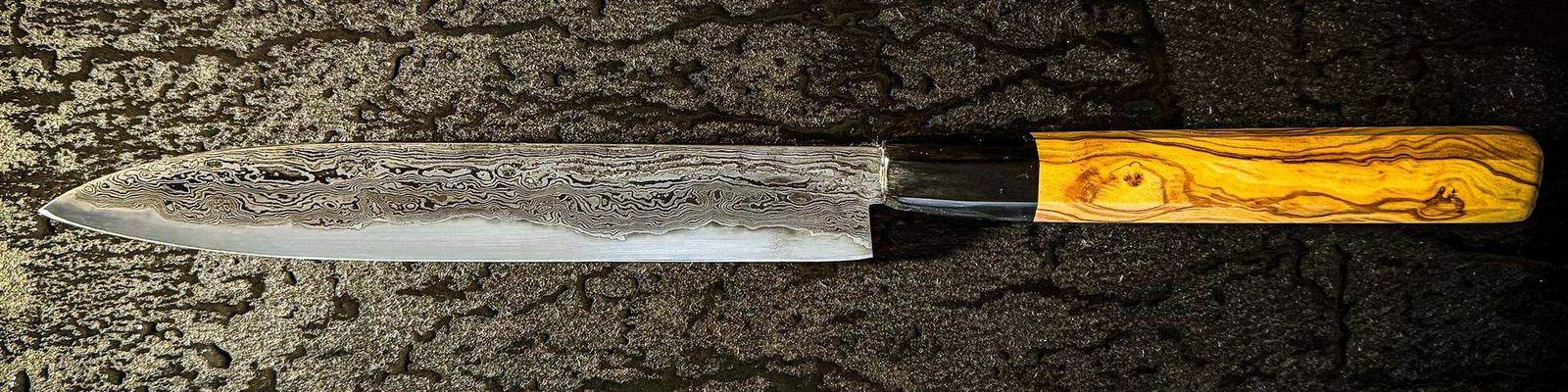
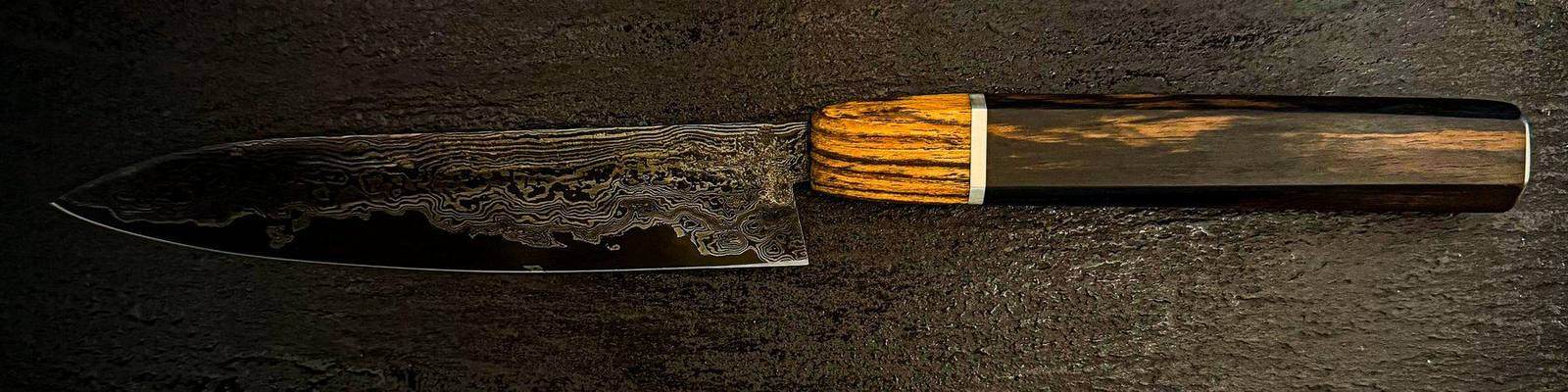
Konami – full knife
The same steel, the same fire.
The sea is vast,
the small wave goes its own way.

Konami (小波) is Japanese for “small wave.” In Hokusai’s “Great Wave off Kanagawa,” the huge wave rears up over the boats, and in the foreground a small wave traces the shape of Mount Fuji. Konami is forged from the same steel as Unkai (雲海), the sea of clouds. Unkai is the sea, Konami the small wave within it.

Hokusai’s “Great Wave off Kanagawa” as a Chusen Tenugui

At a glance

Details

The story

In the summer of 2026 I was in Japan on business, with a side trip to Sakai, the old city of sword and knife smiths. A heavy, cloudy sky hung over the narrow alleys, and behind the open workshop doors the forges were glowing.

An alley in Sakai, summer 2026

I stood outside Tadashi Enami’s workshop with a sheet of paper in my hand. On it I had written in Japanese who I am: a hobby smith from Germany who deeply admires Japanese bladesmithing and the San Mai technique, and who collects steel on his travels that later becomes knives. And a request: whether he could spare me a small piece of Shirogami or Aogami, happily for payment, as a memory of Japan to go into my next knives. Below the text, photos showed some of my work.

My letter to Tadashi Enami: asking for a piece of steel from Sakai

Tadashi Enami read it, looked at the photos and nodded. Then he put a bar of Aogami into the coals, waited until it glowed bright, and cut off a piece on the anvil with a hot cut: no cutoff grinder, no saw, just heat, chisel and hammer. Then the same with the Shirogami.

Tadashi Enami at the anvil: cutting off the glowing steel
Tadashi Enami’s workshop with the old power hammer

Wrapped in Japanese newspaper and hand-labeled 白 and 青, I walked out of the workshop with the two pieces. One of the moments from that trip that still stays especially close to me.

白 Shirogami and 青 Aogami, labeled by hand

In Sakai I also came across a Tenugui, a cotton cloth dyed using the traditional Chusen method, showing Hokusai’s “Great Wave off Kanagawa.” The great wave rears up over the boats. In the foreground a small wave traces the shape of Mount Fuji.

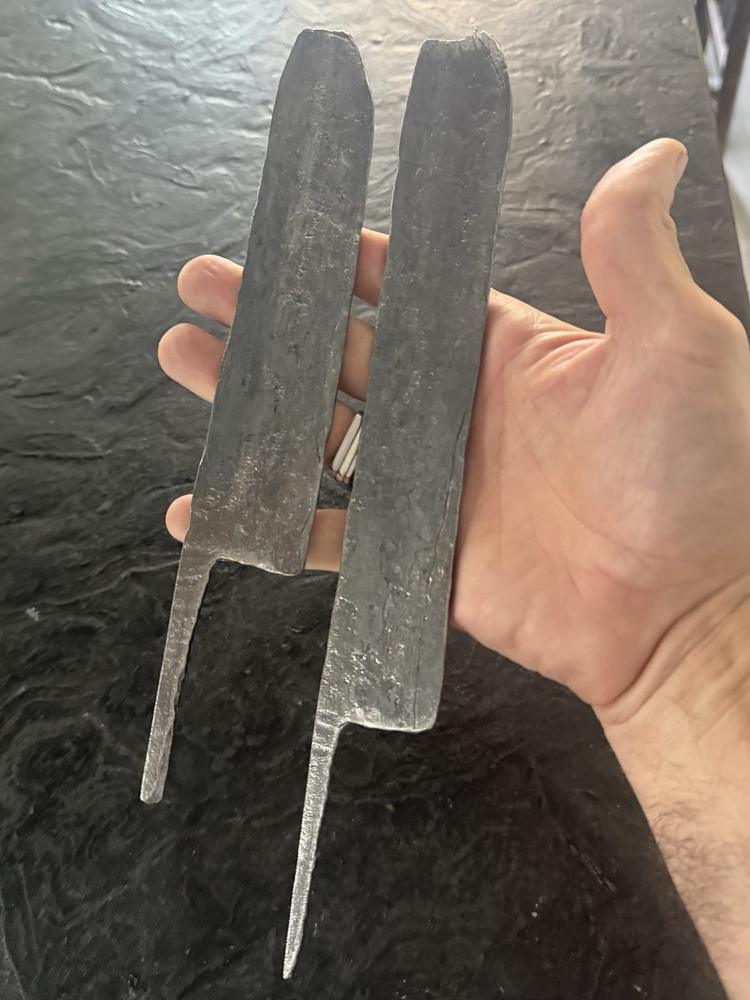
Much like that, two blades later lay side by side in my workshop. From Tadashi Enami’s Aogami and Roland’s 80-layer Damascus I forged two knives, in the same fire, side by side: Unkai, the sea of clouds, and Konami, the small wave. The same steel from Sakai, the same layers from Saarland, the same journey.

Konami is a little shorter and handier than her big brother. Unkai draws long cuts through meat and fish; Konami is the everyday knife: for vegetables, herbs and whatever ends up on the board.
From material to blade

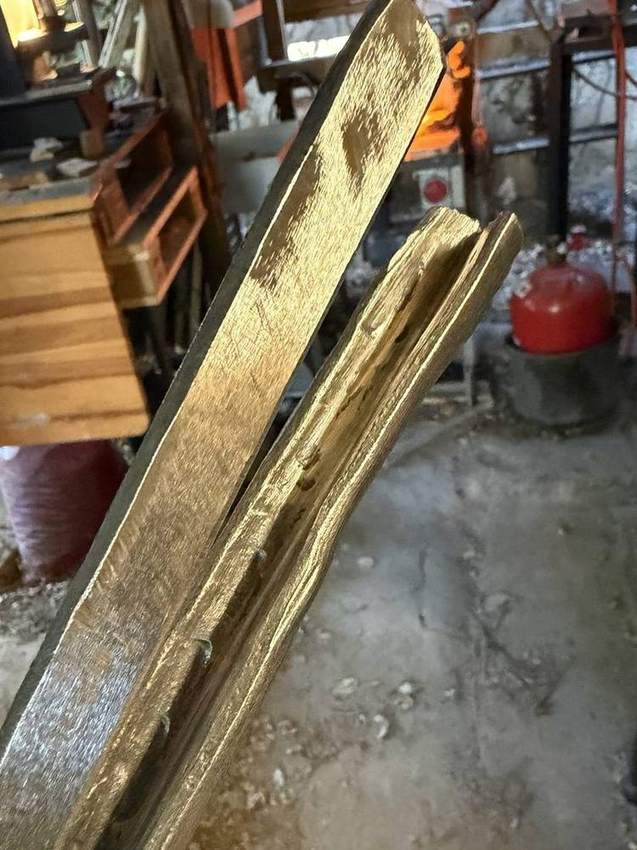
  1. Split open
    01

    Split open

    The Damascus is split lengthwise, and the Aogami core goes into the split.

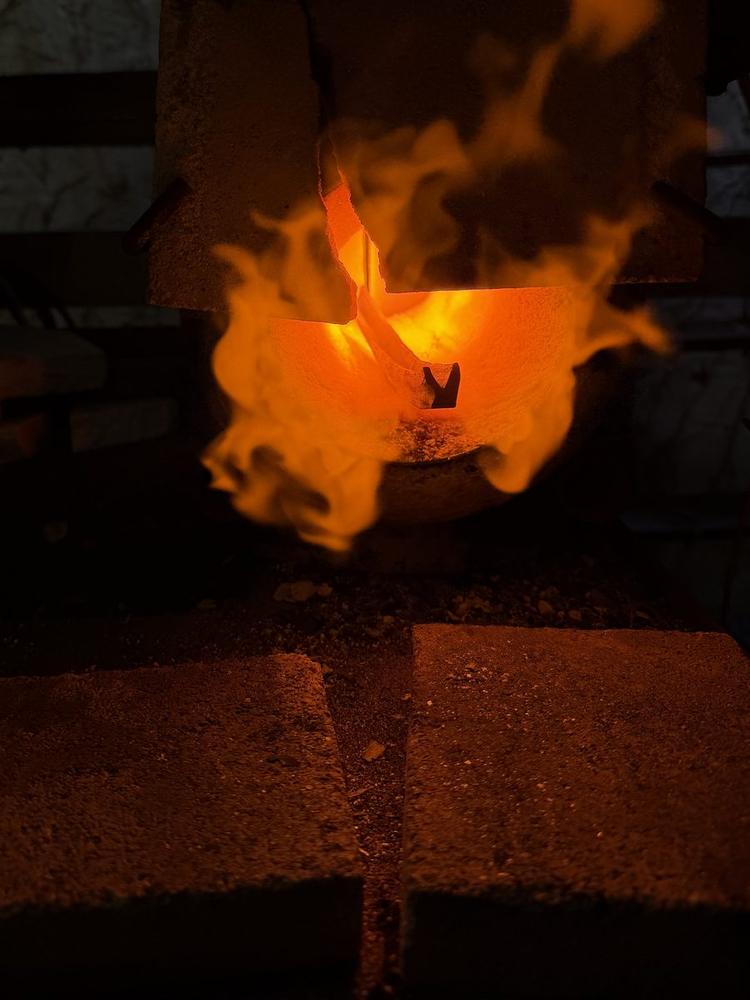
  2. In the fire
    02

    In the fire

    Cladding and core are brought to welding heat in the gas forge and forge-welded.

  3. Two blanks
    03

    Two blanks

    Unkai and Konami, forged side by side from the same steel.

The big brother

Specifications

Steel
Cutting coreAogami, from Tadashi Enami, Sakai (Japan)
CladdingDamascus, 80 layers, forged by Roland
ConstructionWarikomi
PatternRandom · 80 layers
Finishetched
Etchferric chloride, coffee
Grindslightly hollow on the left
ForgeGas
Working timeapprox. 22 hours
Heat treatment
Normalizing830 / 790 / 760 °C
Hardening820 °C
QuenchOil, 60 °C
Tempering2 × 1 h at 190 °C
Hardness
60HRC
estimated (file test)
Dimensions
Overall length321 mm
Blade length175 mm
Blade height32 mm
Spine thickness3 mm
Weight123 g
Handle
WoodMacassar ebony from an old square blank, not stabilized
FerruleZebrano
InterlayersNickel silver
ShapeWa handle, octagonal
TangHidden tang
Work
TypeKo-Gyuto
Work no.8
CompletedSeptember 2026

The smith

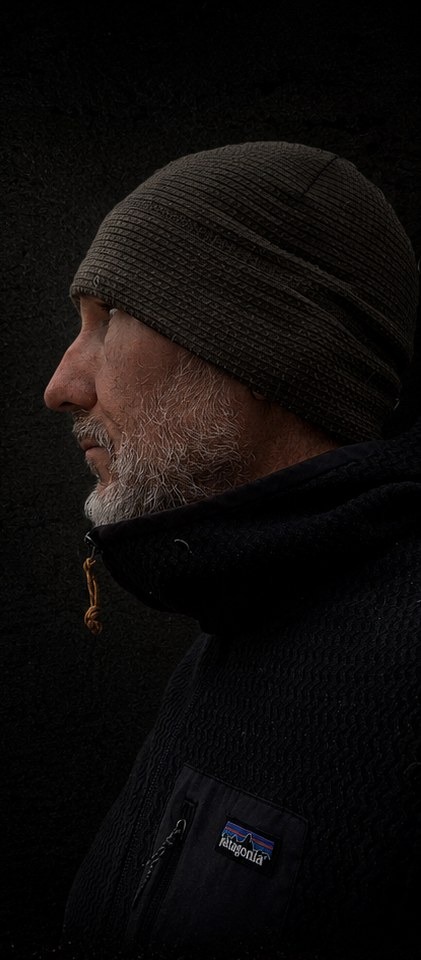
The smith behind DR BLADES

DR BLADES

DR are my initials and also stand for my academic degree. The pun was too good to just leave sitting around. As a drug hunter and researcher, I'm fascinated by how a small molecule has to be built so that it does exactly what it should at its biological target, and how, after a lot of optimization, it eventually becomes a drug. Structure determines function. One more or less atom, one bond that is twisted differently, and everything changes.

I find the very same thing at the forge. Here, too, shape and properties determine what a knife can do in the end. Hardly any material can be transformed like steel. The temperature control alone decides whether the same blade turns out soft, hard, too brittle or just right.

I bring many of my materials back from travels and outdoor activities. A rusty axe head found between the rocks on a Norwegian fjord, Aogami and Shirogami from Sakai in Japan, masur birch from Karelia, reindeer and moose antler from Lapland. Others come from our garden or from friends.

Each one carries a piece of history. It shouldn't disappear in the finished knife. The old iron is allowed to look old, the wood to show its wounds. That is exactly what each of my knives tells.

Care