DR BLADESDR Blades No. 1a

Kizuna

What binds, holds.
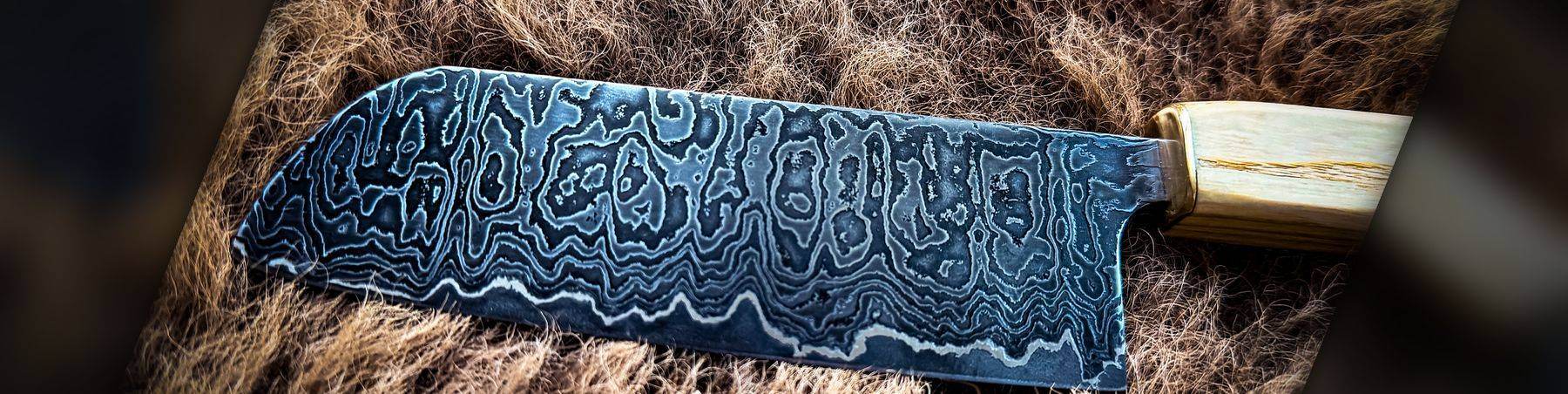
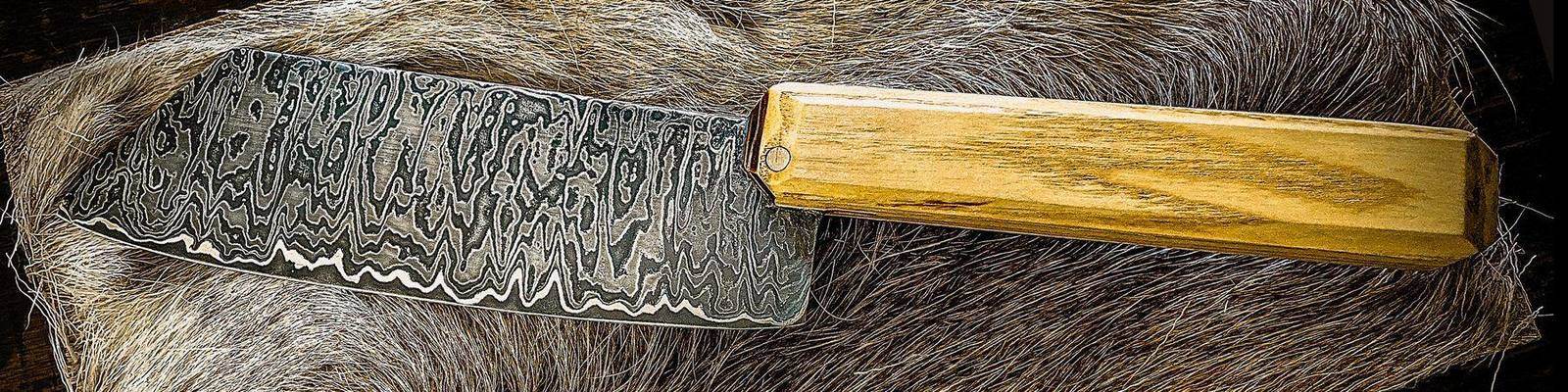
Kizuna – full knife
A lab, an open door,
a spark that caught.
What it kindled is still burning today.

Kizuna (絆) is Japanese for “bond, connection”: what holds people together. It stands for ties you cannot see but that carry weight. Kizuna is the counterpart to Kasugai (鎹), the iron cramp. The cramp holds the beams together, the bond holds the cramp.

At a glance

Details

The story

Kizuna is the Santoku that belongs with Kasugai. Both knives date from the early days and bear the same signature: a cutting core of Apex Ultra, surrounded by Damascus, with a paper-thin nickel foil in between as a diffusion barrier. It shows as a bright, restless line above the edge, like a seam holding the two layers together. Above it, the Damascus flows in wide, cloudy arcs.

Kizuna is a gift for Gregor, a very special person in my life. He took me into his lab early on, when I was still a student, and lit the fire for science in me there. Much of what drives me today, in the lab as much as at the forge, began there: the curiosity about how things are built and why they work, and the patience to keep trying, changing and starting over until something finally works.

A knife is a small thank-you for something so big. But it is made from fire, and that fits. The handle is ash, plain and light, as on Kasugai.
From material to blade

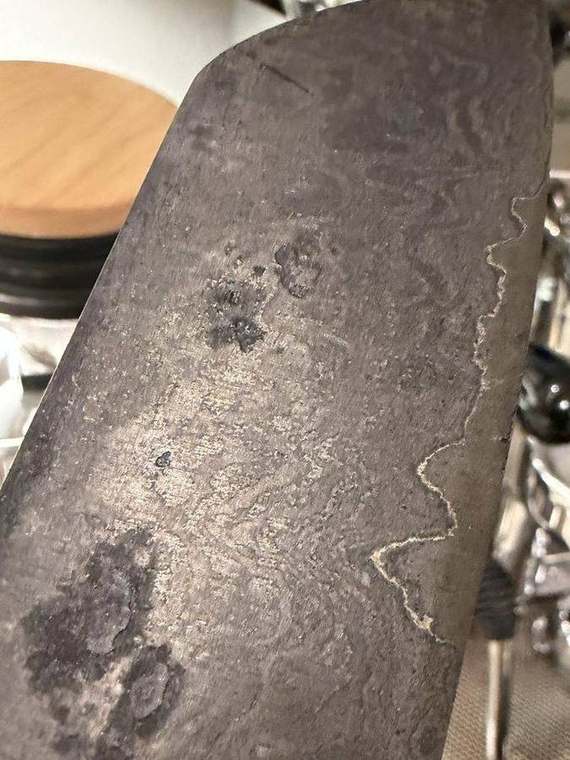
  1. Before the final etch
    01

    Before the final etch

    The blade still dull and gray. The nickel foil already shows as a bright seam above the edge.

Belonging together

Specifications

Steel
Cutting coreApex Ultra
Side layersDamascus
Diffusion barrierNickel foil
ConstructionSan Mai
PatternRandom · 60 layers
Finishetched
Etchferric chloride, coffee
ForgeCoal
Working timeapprox. 20 hours
Heat treatment
Normalizingwithout a heat-treating oven
Hardeningred hot, in the coal forge
QuenchOil, 60 °C
Temperingnone – we didn't know about that back then
Hardness
55–60HRC
estimated (file test)
Dimensions
Overall length248 mm
Blade length143 mm
Blade height39 mm
Spine thickness2.1 mm
Weight118 g
Handle
WoodAsh from an old canoe seat, not stabilized
FerruleBrass
ShapeWa handle, octagonal, one piece
TangTang, held by a brass pin
Work
TypeSantoku
Work no.1a
CompletedApril 2025

The smith

The smith behind DR BLADES

DR BLADES

DR are my initials and also stand for my academic degree. The pun was too good to just leave sitting around. As a drug hunter and researcher, I'm fascinated by how a small molecule has to be built so that it does exactly what it should at its biological target, and how, after a lot of optimization, it eventually becomes a drug. Structure determines function. One more or less atom, one bond that is twisted differently, and everything changes.

I find the very same thing at the forge. Here, too, shape and properties determine what a knife can do in the end. Hardly any material can be transformed like steel. The temperature control alone decides whether the same blade turns out soft, hard, too brittle or just right.

I bring many of my materials back from travels and outdoor activities. A rusty axe head found between the rocks on a Norwegian fjord, Aogami and Shirogami from Sakai in Japan, masur birch from Karelia, reindeer and moose antler from Lapland. Others come from our garden or from friends.

Each one carries a piece of history. It shouldn't disappear in the finished knife. The old iron is allowed to look old, the wood to show its wounds. That is exactly what each of my knives tells.

Care