DR BLADESDR Blades No. 1

Kasugai

What holds is more than steel.
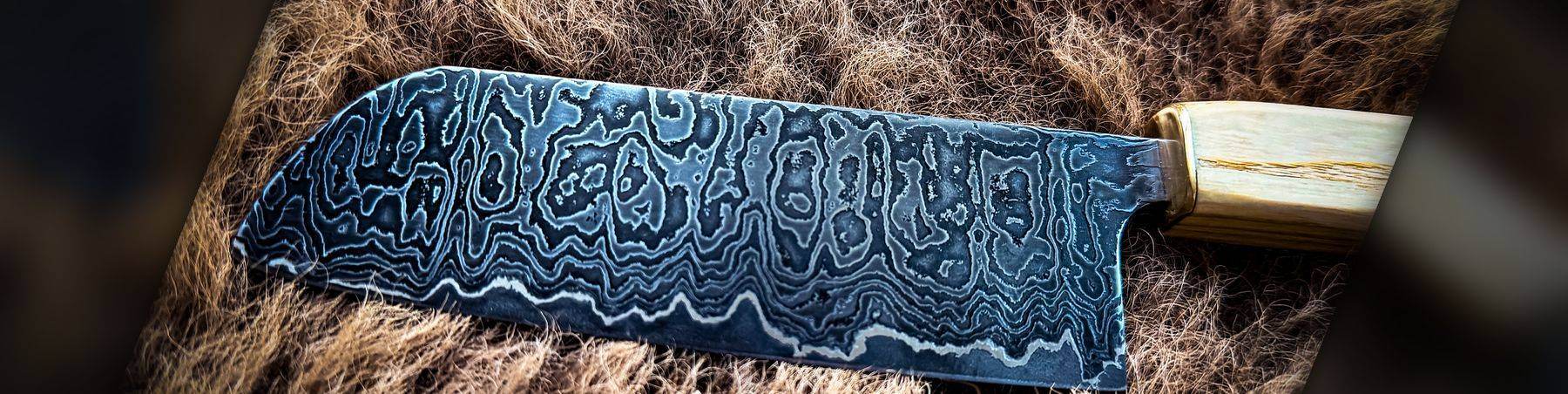
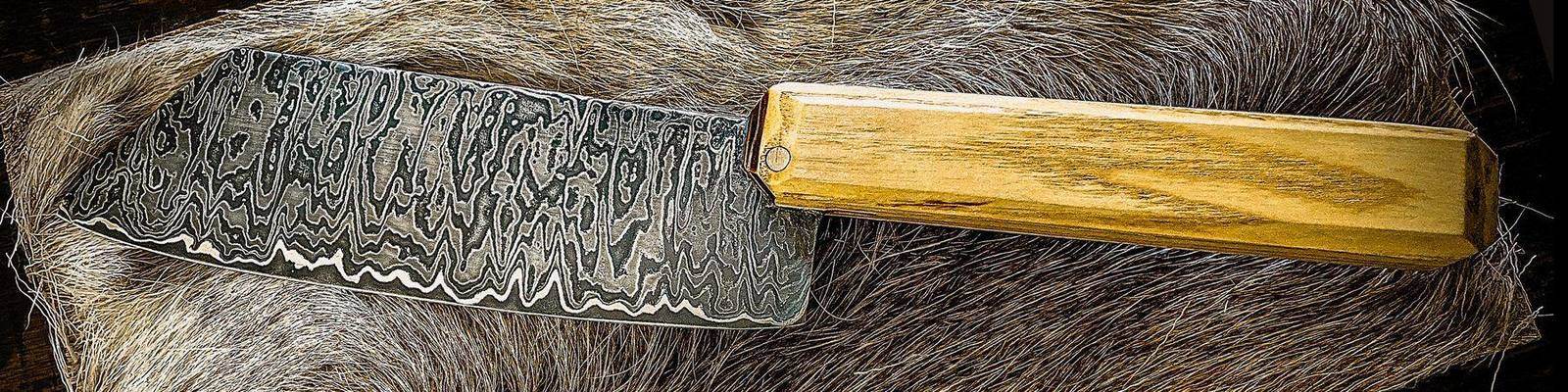
Kasugai – full knife
A tang that came out too short.
A brass pin straight through.
Sometimes the smallest thing holds it all together.

Kasugai (鎹) is the iron cramp carpenters use to join beams. Japanese has a saying, “Ko wa kasugai”: children are the cramp that holds a family together.

At a glance

Details

The story

This is one of my first knives, and yet there is more ambition in it than you would guess. The cutting core is Apex Ultra, surrounded by Damascus. Between them lies a paper-thin nickel foil as a diffusion barrier. It keeps the carbon from migrating out of the hard core into the Damascus in the fire, and it shows as a fine bright line along the edge.

Back then we only had a coal forge. Its heat is hard to tame, and every time we fired it up we were afraid of burning the carbon steel.

I was so absorbed in the billet, in folding, welding and forging out the layers, that I lost sight of the tang. When the blade was done, it was too short. That is why the whole knife was deliberately kept simple, the handle too: a single piece of ash from an old canoe seat, ground octagonal.

The blade is held by a brass pin running crosswise through the handle. The pin is small and inconspicuous, and yet it holds everything together. That is exactly why it suits this knife.

I gave it to my wife for Mother's Day 2025. Certainly not perfect, but made with everything I could do at the time.
From material to blade

  1. The billet
    01

    The billet

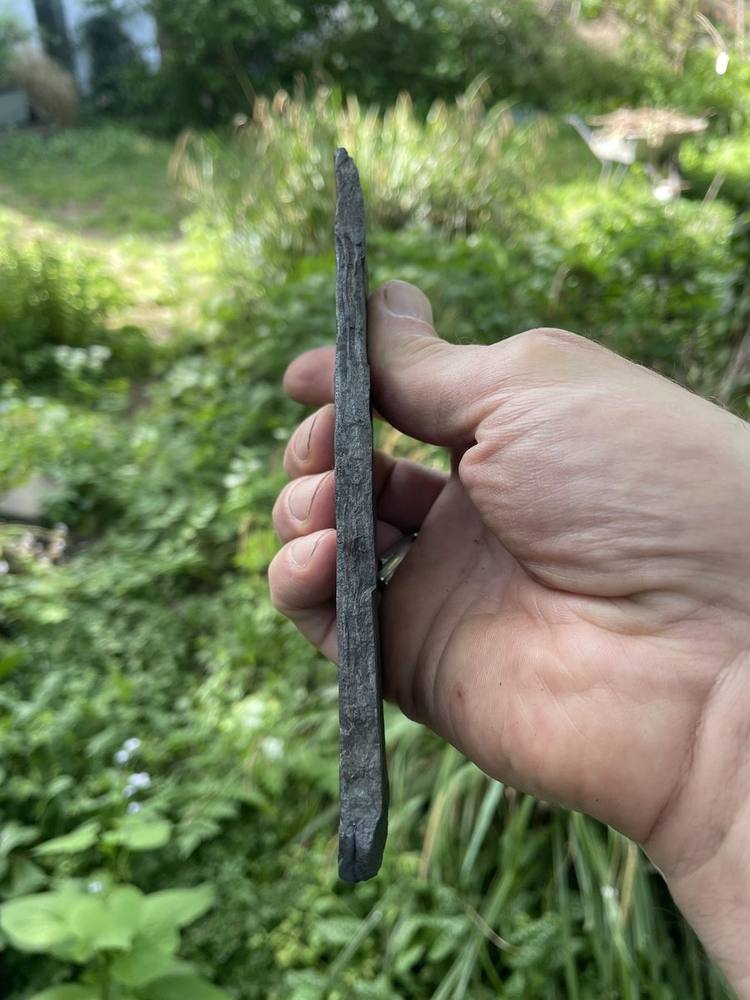
    Damascus, nickel foil and Apex Ultra, forge-welded and drawn out flat in the coal forge.

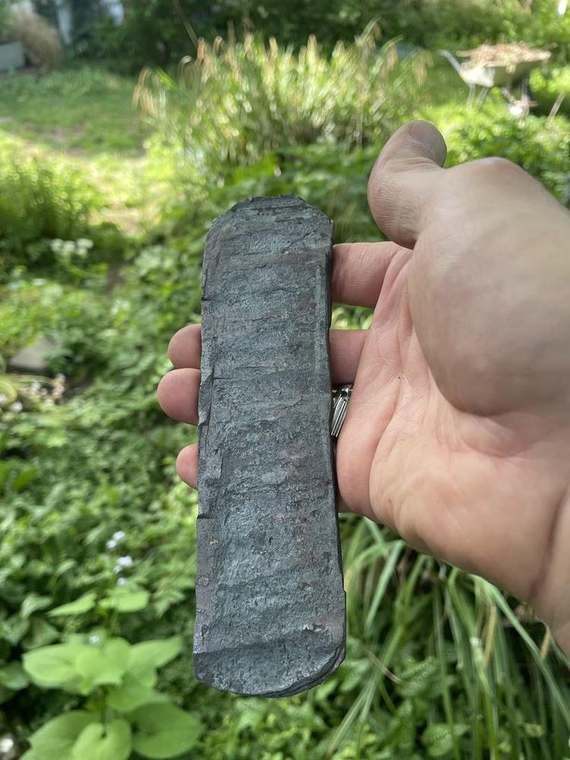
  2. In profile
    02

    In profile

    The rough blade from the side, still covered in scale, before the shape takes form.

Belonging together

Specifications

Steel
Cutting coreApex Ultra
Side layersDamascus
Diffusion barrierNickel foil
ConstructionSan Mai
PatternRandom · 60 layers
Finishetched
Etchferric chloride, coffee
ForgeCoal
Working timeapprox. 20 hours
Heat treatment
Normalizingwithout a heat-treating oven, by eye
Hardeningred hot, in the coal forge
QuenchOil, 60 °C
Temperingnone – we didn't know about that back then
Hardness
55–60HRC
estimated (file test)
Dimensions
Overall length245 mm
Blade length140 mm
Blade height39 mm
Spine thickness2.2 mm
Weight116 g
Balance pointwhere the blade meets the handle
Handle
WoodAsh from an old canoe seat, not stabilized
ShapeWa handle, octagonal, one piece
TangTang, secured with a brass pin
Work
TypeSantoku
Work no.1
CompletedApril 2025

The smith

The smith behind DR BLADES

DR BLADES

DR are my initials and also stand for my academic degree. The pun was too good to just leave sitting around. As a drug hunter and researcher, I'm fascinated by how a small molecule has to be built so that it does exactly what it should at its biological target, and how, after a lot of optimization, it eventually becomes a drug. Structure determines function. One more or less atom, one bond that is twisted differently, and everything changes.

I find the very same thing at the forge. Here, too, shape and properties determine what a knife can do in the end. Hardly any material can be transformed like steel. The temperature control alone decides whether the same blade turns out soft, hard, too brittle or just right.

I bring many of my materials back from travels and outdoor activities. A rusty axe head found between the rocks on a Norwegian fjord, Aogami and Shirogami from Sakai in Japan, masur birch from Karelia, reindeer and moose antler from Lapland. Others come from our garden or from friends.

Each one carries a piece of history. It shouldn't disappear in the finished knife. The old iron is allowed to look old, the wood to show its wounds. That is exactly what each of my knives tells.

Care