 DR BLADES
Smithy, workshop and tools
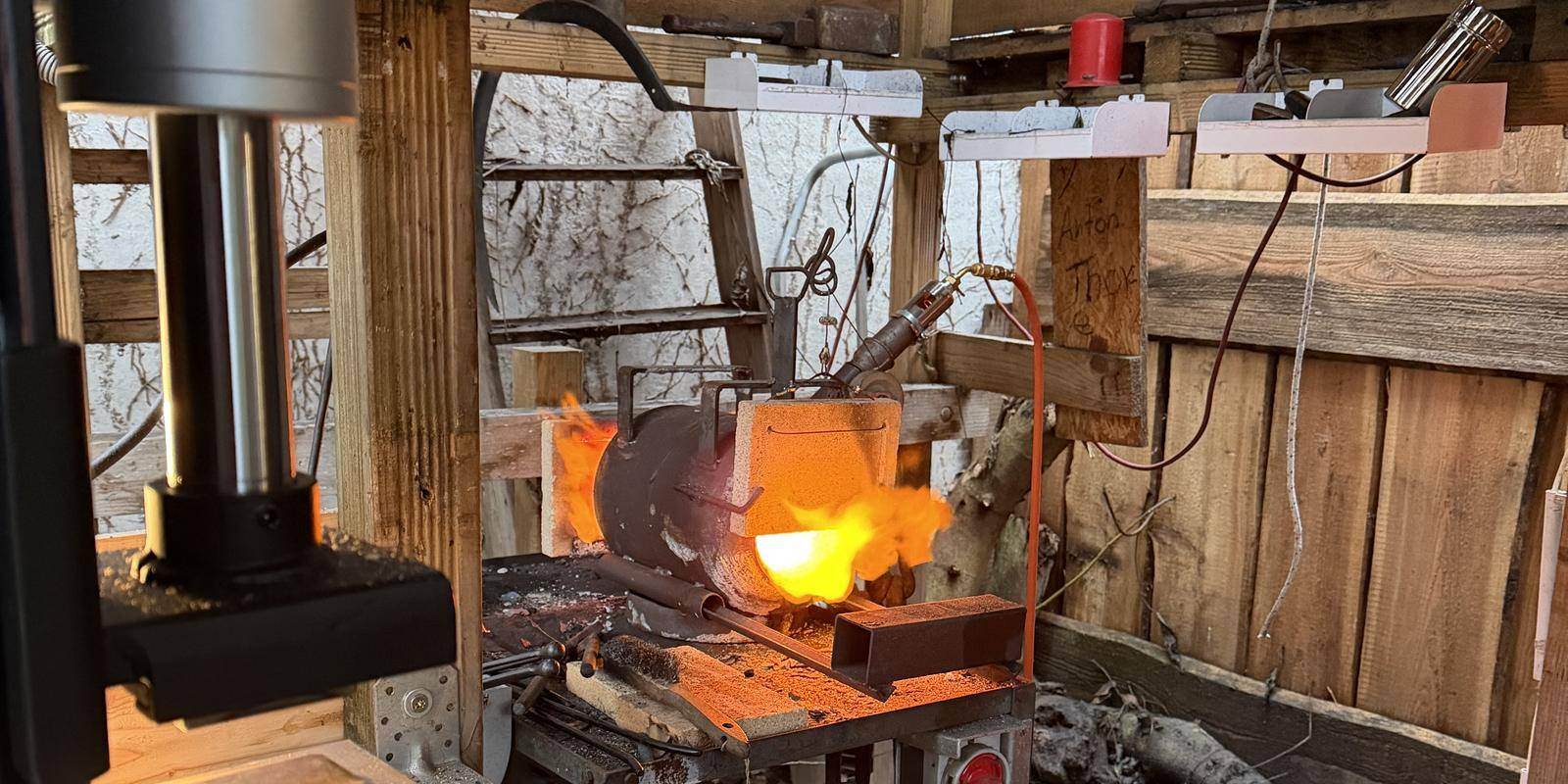
A converted log splitter, a band saw from the sixties for thirty-five euros and a press from Denmark – how the workshop grew piece by piece.
Forge & workshop in detail
The log splitter
The more we forged, the clearer it became that anvil and hammer alone wouldn't get us any further. Damascus needs pressure. So I converted our Scheppach log splitter, a very simple machine with about six tons. The inspiration once again came from YouTube.
With a foot pedal and a wobbly wooden frame it became our first forging press, and it could do more than it looked like. The first Damascus billets and the first knives were made on exactly that.
A band saw from Dortmund
By now I could weld a bit and build swage dies myself. But for the prep work I still lacked a metal band saw. Through the online classifieds I was able to pick one up in Dortmund, built in the sixties, an enormously heavy thing for thirty-five euros. It runs flawlessly.
Twenty tons from Denmark
At some point the homemade press had reached its limit. The billets couldn't get any bigger, the force wasn't enough, and the frame was pulling and warping all over. A power hammer is unfortunately not an option for us (yet) – because of the neighbors and their masonry. So it became a proper press: twenty tons, built by Jens Lorenzen in Denmark.
Piece by piece
Otherwise, a lot has been added piece by piece. A blacksmith's vise from a farmer in the area, again through the online classifieds. Anvil, vise and the forges are outside at the forge in the garden. The woodshop with belt grinder, table saw, band saw, drill press, heat-treating oven and everything else that goes with it is in the basement. A cyclone handles dust extraction at the machines.
Steel, borax and ferric chloride
At first we bought our steel from the usual online dealers: 75Ni8, 1.2842 and nickel foil. I get borax as flux and ferric chloride for etching through my wife's pharmacy. Sometimes things just fall into place.
YouTube University
On my path of discovery I learn a lot from others, and “YouTube University” contributes quite a bit in this workshop. Instructive teachers for me are: Küstenklinge, Saarlandschmiede, Der blecherne Alex, Einfach Schmieden!, Der Letzte seines Standes, Spira Knives and Alp Knives with 63HRC, Sperber Knives, Alec Steele, Freizeitflugsphäre, JP's Bladeworks, Martin Huber Knives, Michael Tessin, Tyrell Knifeworks and many others. Thank you all for showing and explaining!