 DR BLADES
From a forging course to the first usable knives
My sons are good with their hands and artistically gifted. In Finnish Lapland my oldest once found a piece of pine and saw an eagle in it, which he then carved out. Somehow he has the same eye for steel. Today he forges wonderful roses, key rings, hooks and buckles.
His first real lessons were a gift from his aunt in Recklinghausen. Two days with a smith in the Ruhr area. There he learned how to stand at the anvil, how to guide and heat the iron, how to forge a point. When he left he was given a hammer and a proper pair of tongs. That mattered, not least for safety, because being self-taught, I couldn't really teach him that myself.
Damascus in Bruchsal
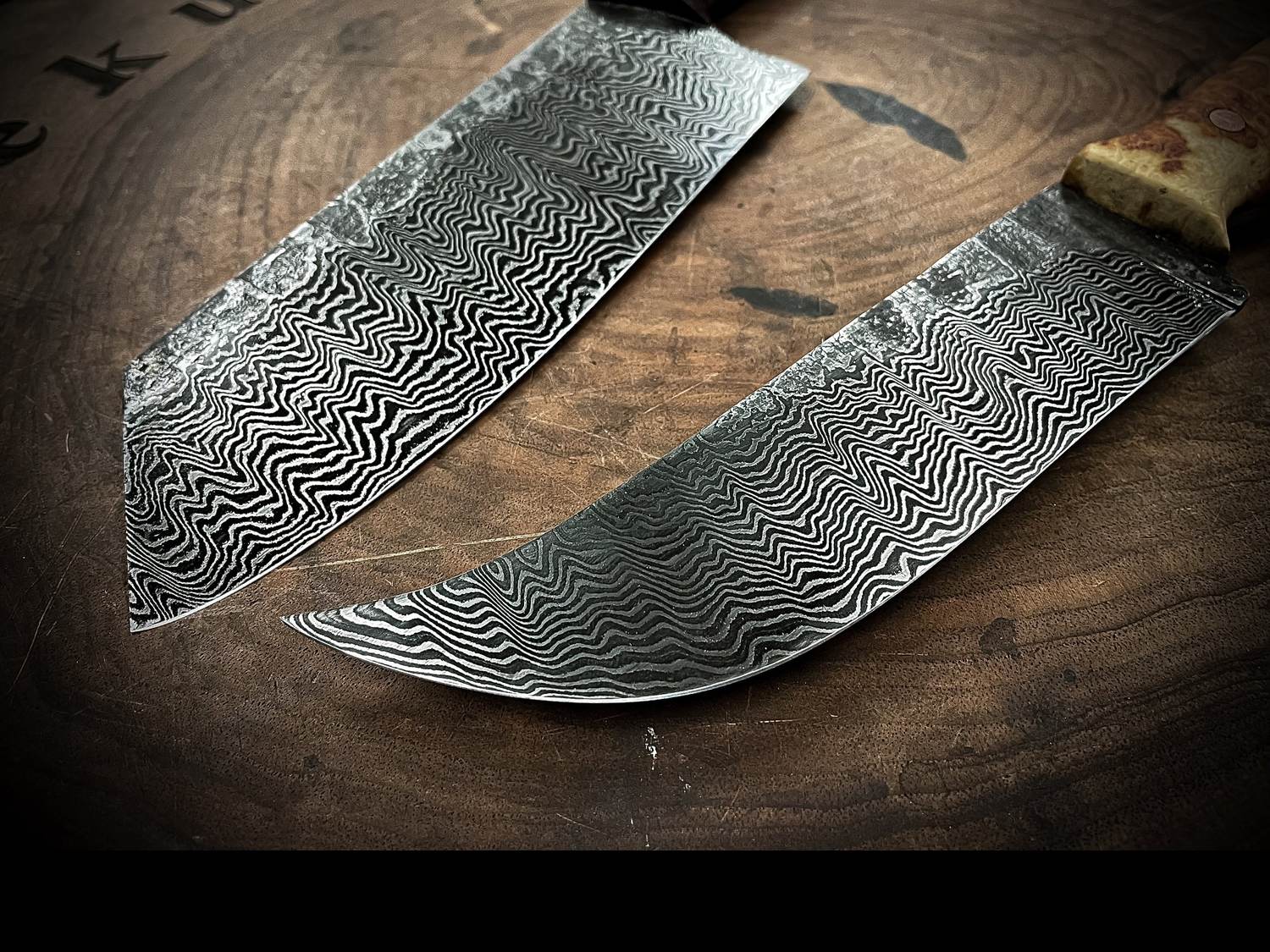
Then at Christmas came the idea of Damascus. A two-day course with master smith Nico Runge in Bruchsal. Forging Damascus on the first day, making a knife from it on the second. My oldest was fourteen at the time, and strictly speaking that wasn't allowed, because they work with power hammers there … It was only permitted with an accompanying adult. So I simply joined in, even though I had actually wanted him to learn this without his dad.
In April we drove there in the camper. We had come up with knife shapes, drawn them on wood and cut them out. Over two days we forged, ground, etched and fitted the handles. We still have both knives. And when the pattern appeared in the Damascus after etching, we were hooked for good!
Looking back, Nico's condition was the best thing that could have happened to us. I really only wanted to stand by and watch. But because I had to take part, the spark somehow jumped over to me too. I would have built the forge in the garden for the kids either way. But without those two days there certainly wouldn't be any knives of my own.
In our own forge
Back home is where it really got going. Our first knives were made of wrought iron, which doesn't really harden. So first we had to get to grips with steel and heat treatment. Then came our first own Damascus billets. Hard going, because at Nico Runge's there were gas forges and power hammers, and at home we had the coke forge and a sledgehammer. I had the coke, Fettnuss 4, shipped from Poland by the sack, 25 kilos a sack, three or four sacks at a time. My son was in the forge practically day and night and burned through the stuff faster than I could reorder it. For the billets we also needed a welder. I do have a well-equipped hobby woodshop, but I had never had anything to do with metal, let alone welding. So, online classifieds again, this time an old Elektra Beckum from a carpenter nearby.
I often wrote on my son's behalf: fourteen years old, interested in forging, needs a welder. That almost always worked. People lowered their prices or threw in extra things, because they were glad their tools were going to young hands.
The welding itself didn't work at all at first. Getting a face shield, finding the right electrodes, and then the electrode kept sticking. Once again, YouTube University came to the rescue. Even so, our first seams were more like gluing with slag than real welding. All in all, a very steep learning curve.
To get the blades into shape we then needed a belt grinder too. Through the Schmiedeshop Angele a Radius Master came into the house, an Australian make, very well thought out. A considerable investment, but without a belt grinder you can hardly get anywhere.
In the fall we then got a kit for a gas forge from the smith Peter Abel in Rhineland-Palatinate. A retired gas bottle, refractory cement, mineral wool, burner and instructions. Put it together, and the coke era was over for the time being.
Protective gear
And then came Christmas. The boys got a powered air system from 3M, a hood with a fresh air supply so no metal dust gets into their lungs at the belt grinder. Plus face shields, gloves, coats, leather aprons.
Even so, we ended up at the eye clinic in Mannheim quite a few times. My oldest twice, once a piece of metal in his eye, once slag, and with the youngest as well – a Nerf dart … They knew us there. It wasn't the fault of the protective gear, but those visits made it clear once more how important it really is. Above all, the boys took it to heart themselves because of it!
The knives and the leather
The following year we went back to Nico Runge, this time for a one-day course in making leather sheaths. My youngest came along. After a few hours it was clear he has a knack for this kind of craft. He works quickly and with obvious joy and now makes the most amazing sheaths for our knives. So we stocked up … vegetable-tanned leather from the Black Forest, dyes, awls and everything else that goes with it. That may be the best thing about this hobby. It never really gets boring. You work with iron and steel, with brass, copper and other non-ferrous metals, with wood, horn and leather. You forge, weld, grind, harden, etch, sew and carve, and every new knife adds something you couldn't do before.