 DR BLADES
Lots of material from Roland, the smith from Saarland
From a heat-treating oven to much more
What we were still missing was a heat-treating oven. Without one, heat treatment is pure guesswork. So, back to the online classifieds, and this time the trail led to Saarland. In December I drove to Saarbrücken with my wife and my youngest. My oldest, the one who is actually into forging and got this whole thing started, couldn't come; he was out hunting. In Saarland we met Roland. A former miner. He was part of the last shift that went down the pit in Saarland in 2012. He learned metalworking underground. His great passion is knifemaking, but he had to give it up for health reasons; his eyes and hands won't cooperate anymore. He showed us his knives, in a display case in his study. Every shape, every material, the full show. And there I stood with my few months of experience. Too bad my oldest didn't get to see it. We bought the heat-treating oven, and when Roland heard that my youngest likes working with wood, he opened his garage and threw in a pen-turning set, plus loads of wood blanks. On our way out he mentioned, almost in passing, that he wanted to part with all of his forging equipment. My wife said afterward that she had never seen such a tidy workshop. His garage was spotless and packed with all the gear we were still missing … We tried out the Efco heat-treating oven and its control unit at home right away and were hooked immediately.
A full van
We stayed in touch, and in January I went back, this time with my oldest and a rented van. I had my eye on a combination Roland had built himself: an anvil on a sturdy stand, welded together with a vise into one unit. Beforehand I went to the bank and withdrew a fair amount of cash, because Roland had no fixed price in mind. We'd come to an agreement, he said.
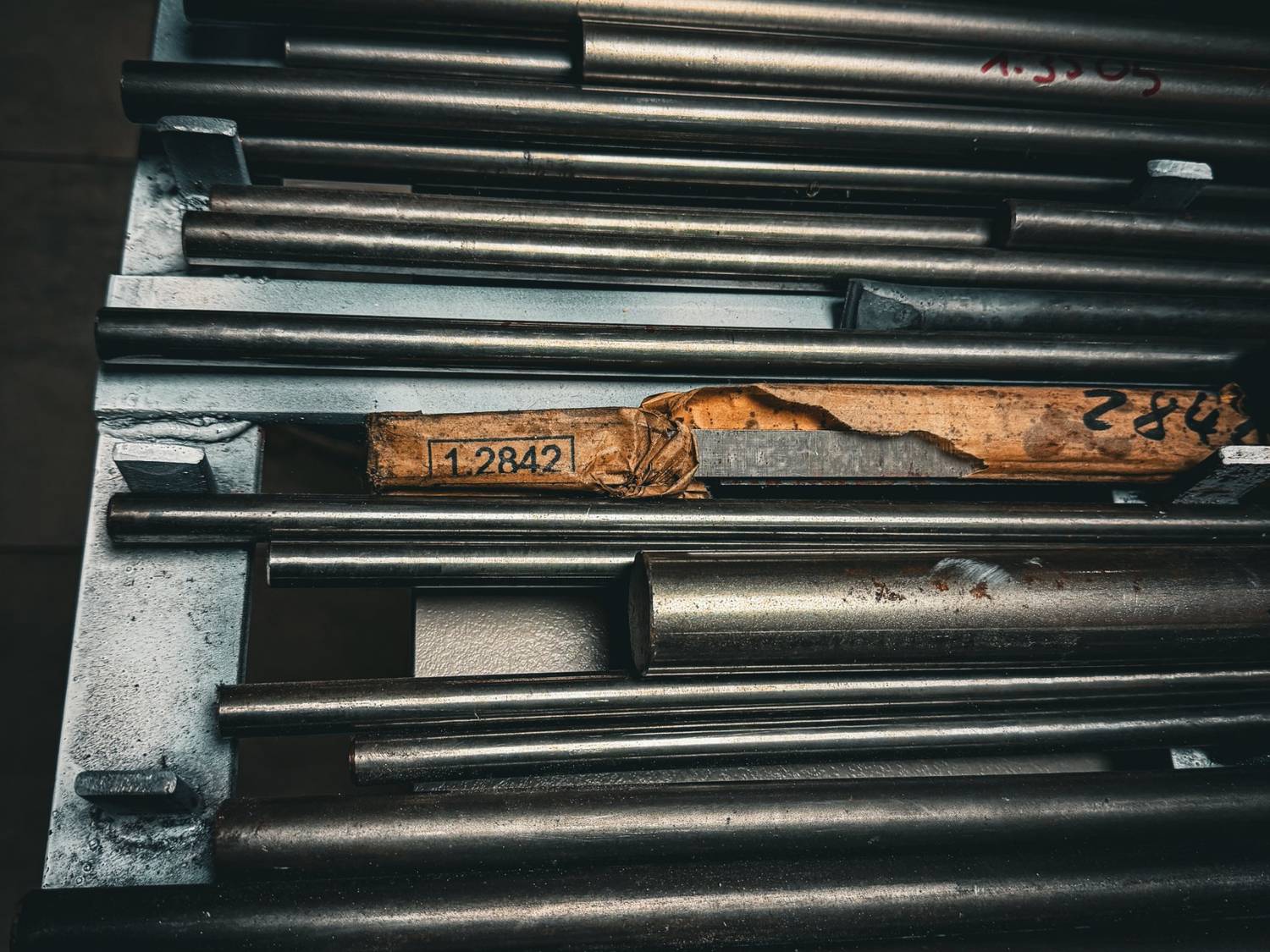
Of course it didn't stop at the anvil and vise. By the end the van was full: bearing steel that later became knives and my honing rods, lots of wood and other handle materials, his knife templates, knife blanks, non-ferrous metal, swage dies and more than a hundred hammers and tongs.
I drove home that day pretty much broke, but it was a good investment. A lot of it has found its way into our work and our knives, and Roland's Damascus in particular keeps turning up. We've stayed in touch, and he plans to visit soon and see what we're doing here.
Sorted and organized
Back home, the first thing we did was go through everything and sort it.
A foundation for the anvil and vise
For the heavy combination we dug out the floor in the forge, and my son prepared the foundation of crushed stone, gravel and large slabs.