
DR BLADESDR Blades No. 18

Hoshikuzu

What went wrong now sparkles.
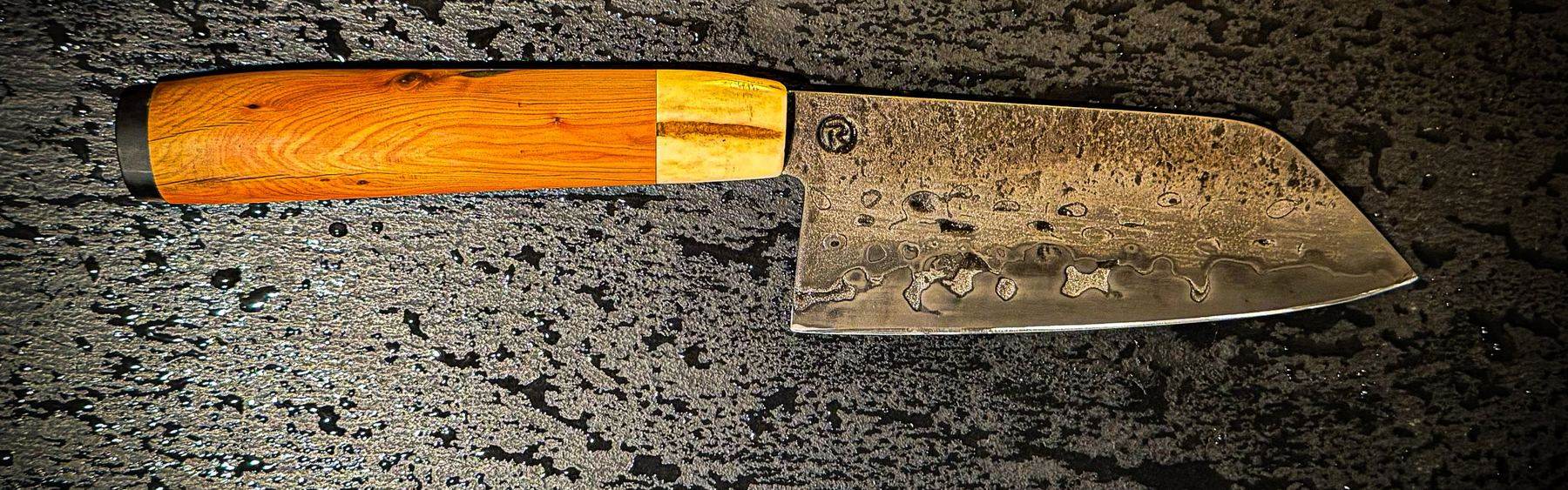
Hoshikuzu – full knife
Rain was the plan.
Slag is what remained.
The acid found stars in it.

Hoshikuzu (星屑) is Japanese for “stardust”: the countless small stars that cover the sky on clear nights. On its own, the character 屑 means “crumbs, scraps”. So here they are literally stars made from what was left over. A Japanese proverb says: “Ame futte ji katamaru” (雨降って地固まる): after the rain, the ground grows firm.

At a glance

Details

The story

Hoshikuzu is a Warikomi: mild steel on the outside, a cutting core of Shirogami in the middle, and a thin nickel foil in between. That was the plan, anyway.

The forge weld, however, did not go well. The nickel foil almost completely oxidized or melted, and a real bond formed only in places. I kept going anyway and drilled shallow holes into both sides of the billet before forging it out further. The goal was a kind of raindrop pattern.

After grinding and hardening, some of the former drill holes still held forge scale and probably slag as well. During hand sanding and in the ferric chloride this scale came off, revealing a sparkling surface underneath that grew more intense with every etch. It glitters like diamond dust, like stars on dark steel. These are probably iron oxides such as FeO and Fe₃O₄, or nickel-rich oxides such as NiO.

Stars over the Adriatic

Starry sky on the Croatian Adriatic coast, fall 2026

In the fall of 2026 we stood on the Croatian Adriatic coast at night under a sky full of stars. The next day I found the wood for the handle in the forest: prickly juniper (Juniperus oxycedrus).

So the stardust came together twice: in the sky above the sea and on the steel.
Specifications

Steel
Cutting coreShirogami from Sakai
CladdingMild steel
InterlayerNickel foil
ConstructionWarikomi
PatternRaindrop, drilled
Finishetched
Etchferric chloride, coffee
ForgeGas
Working timeapprox. 12 hours
Heat treatment
Normalizing950 °C
Hardening840 °C
QuenchOil, 60 °C
Tempering2 × 1 h at 190 °C
Hardness
58HRC
measured (Rockwell)
Dimensions
Overall length280 mm
Blade length140 mm
Blade height52 mm
Spine thickness3.2 mm
Weight169 g
Handle
WoodPrickly juniper (Juniperus oxycedrus), Croatian Adriatic coast, not stabilized
ShapeWa handle
TangHidden tang
Work
TypeBunka
Work no.18
CompletedOctober 2026

The smith

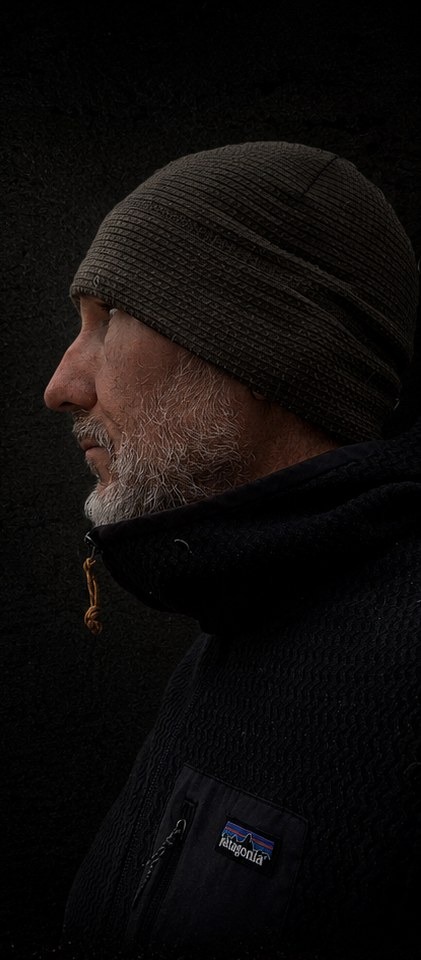
The smith behind DR BLADES

DR BLADES

DR are my initials and also stand for my academic degree. The pun was too good to just leave sitting around. As a drug hunter and researcher, I'm fascinated by how a small molecule has to be built so that it does exactly what it should at its biological target, and how, after a lot of optimization, it eventually becomes a drug. Structure determines function. One more or less atom, one bond that is twisted differently, and everything changes.

I find the very same thing at the forge. Here, too, shape and properties determine what a knife can do in the end. Hardly any material can be transformed like steel. The temperature control alone decides whether the same blade turns out soft, hard, too brittle or just right.

I bring many of my materials back from travels and outdoor activities. A rusty axe head found between the rocks on a Norwegian fjord, Aogami and Shirogami from Sakai in Japan, masur birch from Karelia, reindeer and moose antler from Lapland. Others come from our garden or from friends.

Each one carries a piece of history. It shouldn't disappear in the finished knife. The old iron is allowed to look old, the wood to show its wounds. That is exactly what each of my knives tells.

Care