

DR BLADESDR Blades No. 6

Gullinborsti

What the warthog carried, the blade now carries.
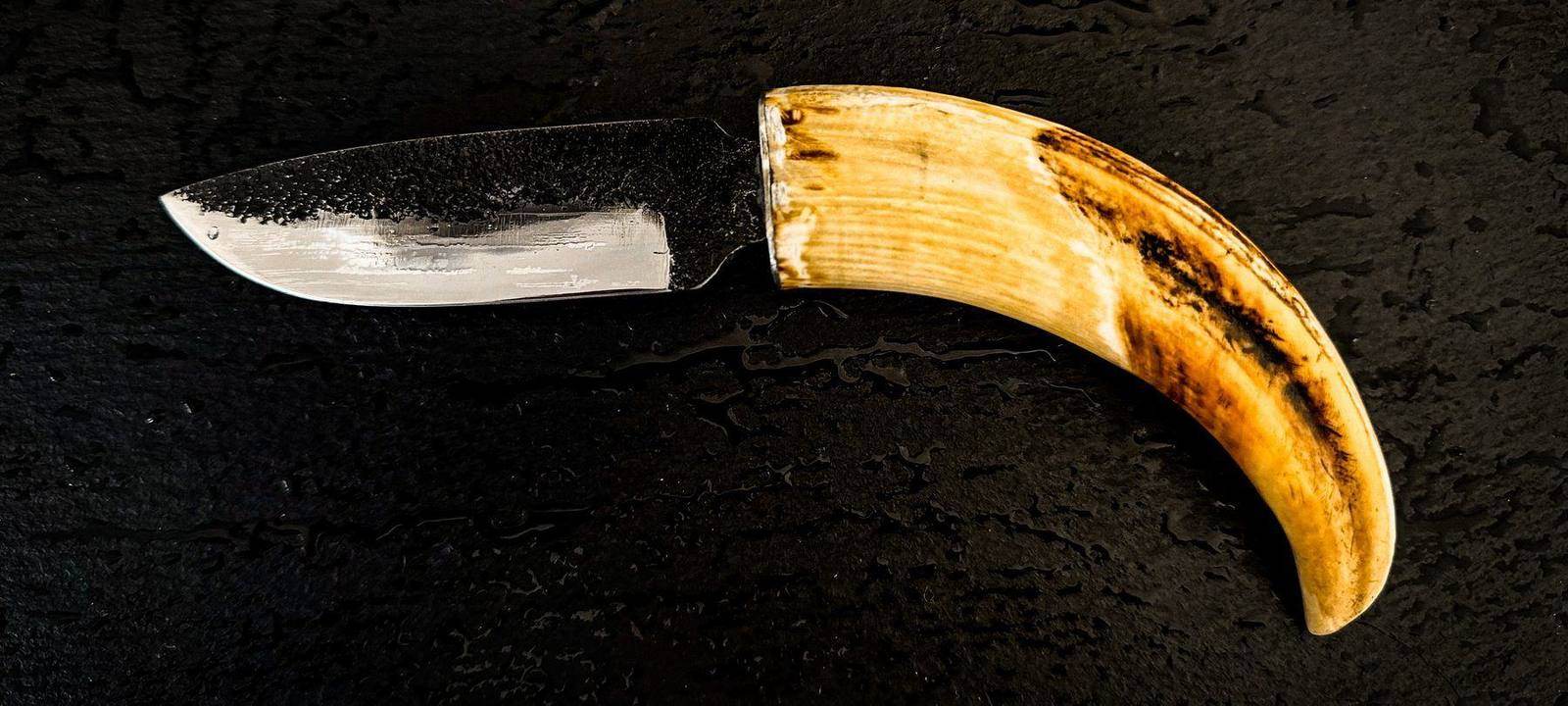
Gullinborsti – knife with a handle made from a warthog tusk
The tusk comes from the savanna,
the blade comes from the fire.
Together they carry the name of the golden boar.

Gullinborsti is Old Norse and means “golden bristles”. In Norse mythology he is the boar of the god Freyr, forged by the dwarf brothers Eitri and Brokkr: Eitri laid a pigskin in the forge, and Brokkr worked the bellows and was not allowed to stop until the work was done. Out came a boar with golden bristles that shone so brightly it lit up the darkest night. An animal from the forge, just like this knife. The rune above the name is Ingwaz, the sign of Freyr.

At a glance

Details

The story

Gullinborsti is a knife conceived from its material. It didn’t start with a design but with a tusk: the canine of a warthog, curved like a crescent moon. I found it in December 2003 in the savanna of Namibia. It waited more than twenty years for its blade.

Warthogs live in the open savanna of southern Africa. They use their tusks to dig for roots and tubers, and to defend themselves. The warm gold, the fine grooves and the dark coloring toward the tip are traces of that life. I didn’t want to change any of it.

The edge in raking light, the tusk above it

The blade blank comes from Roland, the smith from Saarland who has given us a lot of material and even more inspiration. I gave it its final shape and joined it to the tusk. The spine still wears the black forge scale from the fire; only the bevel is ground bright. The rough black and the warm gold of the tusk both speak of fire and wilderness.

The blade is shaped as a Puukko with a Scandi grind, made for work outdoors. Together with the tusk, Gullinborsti sits in the hand like a claw.

My son made the leather sheath. It covers only the blade; the tusk stays free. So even in its sheath the knife remains what it is: a piece of savanna with an edge from the fire.
Specifications

Steel
BladeMono steel, blank by Roland
FinishForge scale, bevel polished
GrindScandi
ForgeGas
Working timeapprox. 15 hours
Heat treatment
QuenchOil
Hardness
57HRC
estimated (file test)
Dimensions
Overall length210 mm
Blade length102 mm
Blade height28 mm
Spine thickness2.7 mm
Weight114 g
Handle
MaterialCanine (tusk) of a warthog
OriginFound in the savanna, Namibia, December 2003
TangHidden tang
SheathLeather, made by my son
Work
TypePuukko
Work no.6
CompletedFebruary 2026

The smith

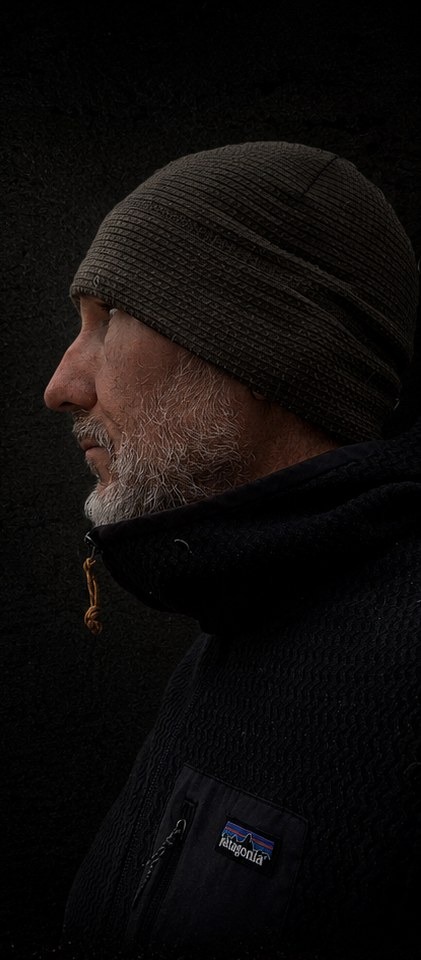
The smith behind DR BLADES

DR BLADES

DR are my initials and also stand for my academic degree. The pun was too good to just leave sitting around. As a drug hunter and researcher, I'm fascinated by how a small molecule has to be built so that it does exactly what it should at its biological target, and how, after a lot of optimization, it eventually becomes a drug. Structure determines function. One more or less atom, one bond that is twisted differently, and everything changes.

I find the very same thing at the forge. Here, too, shape and properties determine what a knife can do in the end. Hardly any material can be transformed like steel. The temperature control alone decides whether the same blade turns out soft, hard, too brittle or just right.

I bring many of my materials back from travels and outdoor activities. A rusty axe head found between the rocks on a Norwegian fjord, Aogami and Shirogami from Sakai in Japan, masur birch from Karelia, reindeer and moose antler from Lapland. Others come from our garden or from friends.

Each one carries a piece of history. It shouldn't disappear in the finished knife. The old iron is allowed to look old, the wood to show its wounds. That is exactly what each of my knives tells.

Care