
DR BLADESDR Blades No. 7

Honing rod

Straightens what leans.
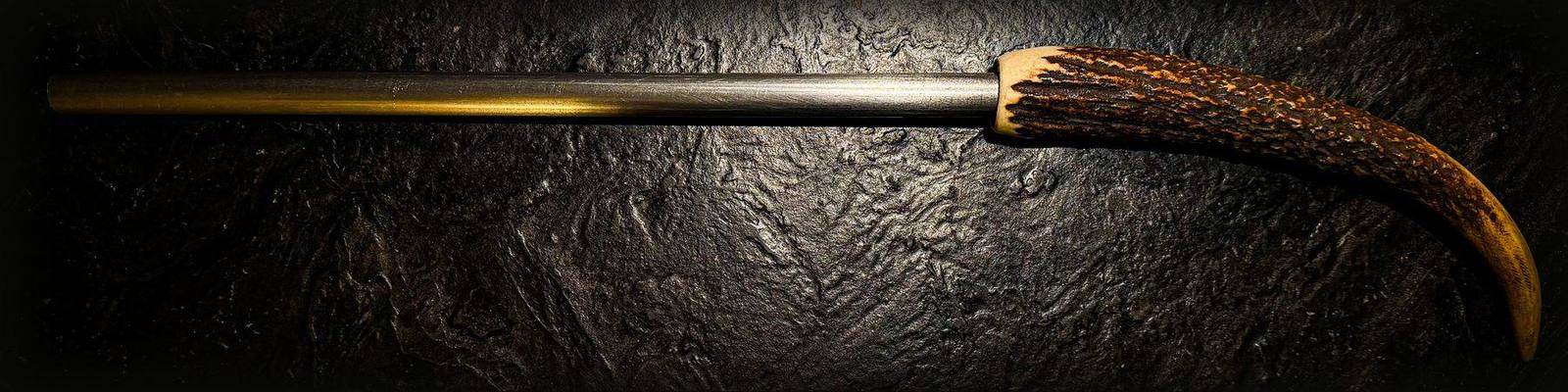
Honing rod with red deer antler handle
A rod of bearing steel,
an antler from the Donnersberg.
Together they keep the edges in line.

A smooth bar of bearing steel, set in the tine tip of a red deer antler. The antler is a forest find from the Donnersberg in Rhineland-Palatinate. The honing rod is my knives’ companion: it keeps their edges in shape between sharpenings.

At a glance

Details

The story

Why an edge feels dull

At its very tip, a sharp edge is only a few thousandths of a millimeter thin. When you cut on the board, or hit bone or a hard shell, this finest part of the edge bends to the side, rolls over slightly or turns wavy. The knife isn’t really dull then. The edge is just no longer in line and meets the food at an angle instead of head-on.

Honing is not sharpening

Sharpening removes material, on the stone or the belt, and creates a new edge. The honing rod does something else. It stands the rolled edge back up and brings it back into line without taking away any steel. That’s why a knife that is honed regularly goes much longer before it has to go back on the stone.

Why hard blades in particular need a smooth rod

High-quality knives with a hard cutting core, such as Apex Ultra or Aogami and Shirogami at 60 HRC and up, need a delicate touch. Their edge is very strong, but less forgiving. A coarsely grooved sharpening steel may not just straighten it but make it chip.

That’s why my honing rod is smooth. It is turned from bearing steel, the steel used for the balls and rings of heavy-duty bearings: very hard, fine-grained and polishable to a mirror finish. A few light strokes away from the edge, alternating left and right at the sharpening angle, stand the edge back up without damaging it. Less pressure is more.

The handle

The tine tip comes from a red deer stag. I found it in the forest on the Donnersberg in Rhineland-Palatinate. The stag polished the pale, smooth tip himself, rubbing his antlers on trees and in the ground.
Size comparison

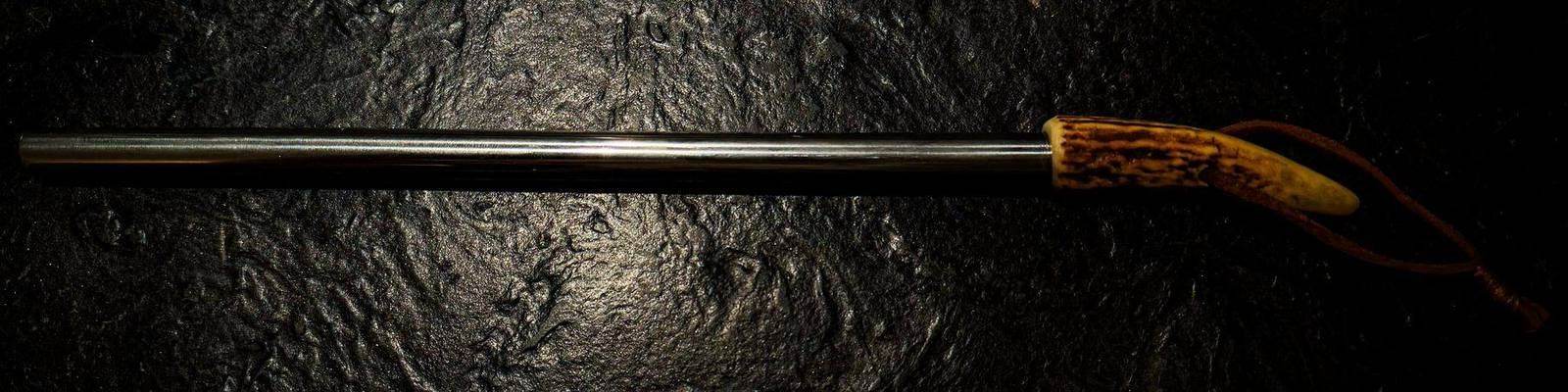
The two honing rods: the big one on top, the small one below
The two honing rods together with one of my knives

The little brother

Specifications

Steel
RodBearing steel 100Cr6 (1.3505)
Designsmooth polishing rod
Diameter14 mm
Finishpolished
Working timeapprox. 1 hour
Hardness
Heat treatmentfactory-hardened
Hardness
58–62HRC
estimated (file test)
Dimensions
Overall length470 mm
Rod length295 mm
Weight480 g
Handle
MaterialTine tip of a red deer antler
OriginForest find, Donnersberg, Rhineland-Palatinate
Work
TypeHoning rod
Work no.7
CompletedSeptember 2026

The smith

The smith behind DR BLADES

DR BLADES

DR are my initials and also stand for my academic degree. The pun was too good to just leave sitting around. As a drug hunter and researcher, I'm fascinated by how a small molecule has to be built so that it does exactly what it should at its biological target, and how, after a lot of optimization, it eventually becomes a drug. Structure determines function. One more or less atom, one bond that is twisted differently, and everything changes.

I find the very same thing at the forge. Here, too, shape and properties determine what a knife can do in the end. Hardly any material can be transformed like steel. The temperature control alone decides whether the same blade turns out soft, hard, too brittle or just right.

I bring many of my materials back from travels and outdoor activities. A rusty axe head found between the rocks on a Norwegian fjord, Aogami and Shirogami from Sakai in Japan, masur birch from Karelia, reindeer and moose antler from Lapland. Others come from our garden or from friends.

Each one carries a piece of history. It shouldn't disappear in the finished knife. The old iron is allowed to look old, the wood to show its wounds. That is exactly what each of my knives tells.

Care