 DR BLADES
How it all began
A forest kindergarten, a medieval market, a few old nails by a Finnish river – and an anvil from 1894.
The first sparks
Actually, the interest in shaping metal with heat and pressure started quite early. My sons went to a forest kindergarten on the grounds of a local adventure garden that had its own smithy. On open days the kids got to go up to the fire themselves and lend a hand.
Later, at an annual medieval market, they stood at the anvil as little boys in leather aprons and hammered iron into shape.
But it only really caught fire in Finland.
Finland, summer 2021
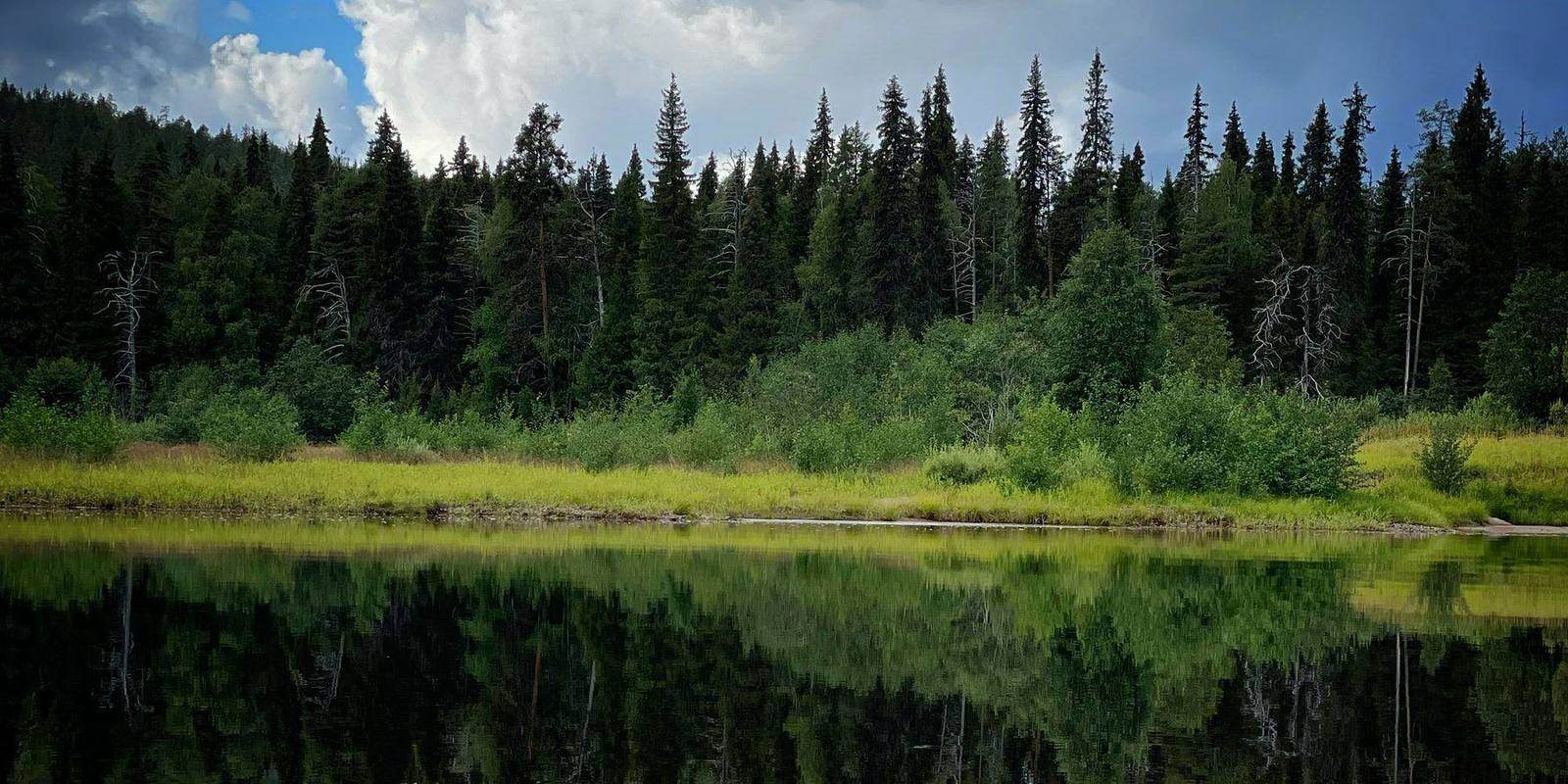
A canoe trip of several days in Oulanka National Park, in the far east of the country near the Russian border. My sons were eleven and nine at the time.
At one of the fire pits on the bank, the two of them found old, heavy nails that had probably once been part of a wooden structure. They had the idea of throwing them into the embers. Then came the simplest forge in the world: a block of wood served as the anvil and the back of the axe as the hammer. Out of that came little knives.
That was when the spark jumped over. The kids had understood that hard iron can be shaped with heat and a few blows. I still have the nails today.
A forge from the Odenwald
Three years later, in the summer of 2024, we were traveling in Scandinavia again, this time with my older son and his friend Justus. Out of nowhere the two of them came up with the idea of setting up a forge in our garden. The only questions were how we'd pull it off and whether the powers that be would play along.
While still in Scandinavia, we searched the online classifieds and found a smith in the Odenwald who wanted to give away his field forge. He was thrilled that young people were interested in smithing and threw in horseshoes, steel and two buckets of coke.
The anvil from Mayen
What we were still missing, of course, was a proper anvil. And those are surprisingly expensive. Old anvils are sold to North America on a large scale; there's a whole trade behind it.
In Mayen, in the north of Rhineland-Palatinate, someone was offering a Söding & Halbach, built in 1894, weighing a hundred and thirty kilos. It came from an old stonemason's workshop. The stonemason had died unexpectedly, and his partner had the difficult task of clearing out the workshop quickly somehow. That's how we got not only the anvil but also an old wagon wheel, hammers, tongs and chains, which now lie around the anvil and make it quieter. The two of us just barely managed to tip it into our T5. Part of that workshop lives on with us.
No three-phase power in the garden
At home, the forge sat idle at first. It was a field forge with a three-phase blower, and in the garden we have everything except three-phase power. So I got hold of a new capacitor and – thanks to AI – rewired the motor's terminal board to star connection. Since then the motor purrs along on 230 volts, and even in the right direction – otherwise we'd have had a vacuum cleaner in the garden instead of a forge.
Lighting the first fire was a challenge all of its own. But when the first iron was hot and my son, wearing the mitten from my childhood, was pounding a glowing piece of rebar on an old swage block as a makeshift anvil, I knew: this has potential!
From chicken coop to smithy
That left only the question of where all this should happen. What would the boss and the neighbors say?
At the very back of our garden, against the back walls of my neighbor's garages, I had once built little huts and towers for the kids. There was also a shed for firewood that later became a chicken coop. That was their refuge, with mud, fire pits and friends. At some point they got too big for it, and the chickens were gone too.
So together with my sons we converted it bit by bit into a smithy and workspace. My younger son got his spot for the lathe there, with a view of the garden.
The best part was that my wife, the mother of my sons, simply let us get on with it – even though the garden is really her little treasure!
Out of sheer joy and gratitude, we promptly used the forge for grilling too: dry-aged beef, caveman style à la Steven Raichlen, laid right on the embers – on charcoal, of course!